
Tool Created by Nasim
Nasim creates practical guides about pool water chemistry, chlorine dosing, and swimming-pool calculations. Author →
A swimming pool shock calculator estimates how much chlorine product you need to raise your pool’s free chlorine from its current level to a target level, based on your pool’s volume and the strength of the product you’re using. To get an accurate number, you need four pieces of information: pool volume, current free chlorine, target free chlorine, and the percentage of available chlorine in the product. Skip any one of those and the result is a guess, not a dose.
This matter because pool shock isn’t a “pour some in and hope” chemical. Too little, and you haven’t actually oxidized the contaminants or chloramines causing that cloudy water or chlorine smell.
What Is a Swimming Pool Shock Calculator?
A swimming pool shock calculator is a tool that converts a desired change in free chlorine into a specific amount of chlorine product typically measured in ounces, pounds, or fluid ounces/gallons depending on whether the product is solid or liquid. To do that, it needs:
- Pool volume. how many gallons (or liters) of water you’re treating. This is the single biggest source of error in manual calculations, because most pools aren’t a perfect rectangle or perfect circle.
- Current free chlorine level, from a recent water test. Not last week’s test chlorine burns off in sunlight and gets consumed by organic material, so yesterday’s number can already be wrong.
- Target free chlorine level. the level you’re trying to reach, whether that’s routine maintenance (1–3 ppm) or a shock/breakpoint treatment (often 10+ ppm depending on your cyanuric acid level and the reason you’re shocking).
- Product type and available chlorine percentage. because a calculator working in “chlorine needed” has to convert that into “product needed,” and different products deliver different amounts of actual chlorine per pound or per gallon.
Table of Contents
How to Use the Pool Shock Calculator
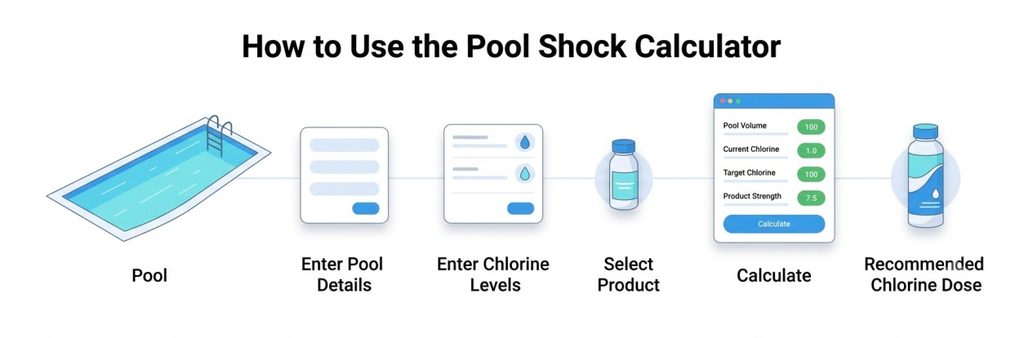
Using ToolBizHub’s swimming pool shock calculator comes down to entering the same four values described above, in the units your test kit and pool measurements already use:
- Enter your pool volume. If you don’t already know it, use a pool volume calculator first length × width × average depth × a shape-specific multiplier, or a dedicated calculator if the pool is round, oval, or an irregular shape. ToolBizHub’s Pool Volume and Pool Gallons calculators can handle this step if you haven’t measured your pool’s total gallons before.
- Enter your current free chlorine reading. taken from a freshwater test not a total chlorine reading, and not a reading from a few days ago.
- Enter your target free chlorine level. For routine dosing this is usually a small increase; for shock treatment it’s a larger jump, often calculated relative to your cyanuric acid (CYA) level using breakpoint chlorination guidance.
- Enter your current & Target pH. Enter the exact pH level of pool and enter what you need pH level.
- Enter your current & Target Alkalinity. Enter the exact current Alkalinity level of pool and enter what you need.
- Select Preferred Sanitizer Dosing Agent. For better water balancing select Sanitizer Dosing Agent from option.
- Select pH Reducer Agent. what agent you like to reduce pH select from option.
The calculator then returns the amount of product to add. From there, the practical step is to add it gradually, per the product label’s instructions, and retest after the manufacturer’s recommended waiting period rather than assuming the number on screen instantly matches the number in the water.
How Pool Shock Dosage Is Calculated
The underlying relationship is simple even though it looks intimidating written out: Amount of chlorine needed = (Target chlorine − Current chlorine) × Pool volume × a conversion constant, divided by the product’s available chlorine percentage.
Chlorine dosing is based on parts per million (ppm), which is a measurement by weight in water. Since one gallon of water weighs about 8.34 pounds, raising the chlorine level by a given ppm across a known volume of water requires a specific weight of pure chlorine and then that weight has to be divided by the product’s strength, because no chlorine product is 100% pure available chlorine.
Written as a formula for weight-based products (like calcium hypochlorite or dichlor): Pounds of product needed = (Target ppm − Current ppm) × Pool volume (gallons) × 8.34÷ (1,000,000 × Available chlorine %, as a decimal)
The 8.34 accounts for the weight of a gallon of water; the 1,000,000 converts the ppm (parts per million) into a usable fraction; and dividing by the available chlorine percentage converts “pure chlorine needed” into “actual product needed,” since a 65%-strength product only delivers 65% as much active chlorine per pound as pure chlorine would.
For liquid chlorine (sodium hypochlorite), the same logic applies, but the result comes out in fluid ounces or gallons rather than pounds, because liquid chlorine’s weight-to-volume ratio varies slightly by product concentration and temperature.
Example: Calculating Chlorine Shock for a Pool
The numbers below are a hypothetical, clearly labeled example not a recommendation for your specific pool.
Say you have a 15,000-gallon pool. A water test shows 1.5 ppm free chlorine, and you want to shock it up to 10 ppm to deal with some cloudiness and a mild chlorine odor (a sign of combined chlorine/chloramines, not too much chlorine). You’re using calcium hypochlorite at 65% available chlorine.
Step 1 Find the required increase: 10 ppm − 1.5 ppm = 8.5 ppm increase
Step 2 Apply the formula:
- Pounds needed = (8.5 × 15,000 × 8.34) ÷ (1,000,000 × 0.65)
- Pounds needed = 1,063,350 ÷ 650,000
- Pounds needed ≈ 1.64 lbs
Step 3 Convert if needed: 1.64 lbs ≈ 26 ounces of 65% calcium hypochlorite. That’s the estimate a calculator using this method would return. In practice, you’d still round to how the product is packaged (many cal-hypo shock products come in 1-lb bags), add it according to the label’s mixing and pouring instructions, wait the recommended time, and retest before swimming.
| Factor | Why it matters |
| Pool volume | Determines how much water is actually being dosed — errors here scale the entire result |
| Current free chlorine | Establishes the real starting point, not an assumed one |
| Target free chlorine | Sets how large the increase needs to be |
| Product concentration | Converts “pure chlorine needed” into “actual product needed” |
Types of Pool Shock and Chlorine
Calcium Hypochlorite (“cal-hypo”) A granular or tablet shock product, commonly available in 65–73% available chlorine. It’s unsterilized (no cyanuric acid), dissolves well when pre-mixed with water, and is a common choice for shocking because of its strength. It does add calcium to the water over time, which matters in pools that already run high in calcium hardness.
Sodium Hypochlorite / Liquid Chlorine Liquid chlorine, typically 10–12.5% available chlorine (higher-strength industrial versions exist but are less common for home use), is unsterilized like cal-hypo but adds no calcium. It’s popular for saltwater and vinyl-liner pools for that reason, though it degrades faster in storage than solid products and its exact strength can drift with age and heat exposure.
Dichlor A stabilized granular chlorine (it contains cyanuric acid), often around 55–62% available chlorine. It’s convenient because it dissolves quickly and doesn’t require pre-mixing, but repeated use steadily raises CYA levels, which over time can reduce chlorine’s effectiveness (a phenomenon often called “chlorine lock” in casual use, though the more accurate description is that high CYA suppresses the killing power of a given free chlorine reading).
Other Products Trichlor is another stabilized chlorine, usually sold as tablets or pucks for slow-release routine dosing rather than shock treatment, because of how slowly it dissolves. No single product is universally “best” the right choice depends on your CYA level, calcium hardness, whether you’re on a salt system, and how quickly you need the dose to act.
How Much Pool Shock Do I Need?
There’s no single dose that applies to every pool, because the amount depends on pool volume, current free chlorine, target free chlorine, the specific product’s concentration, and water conditions like CYA level. A 10,000-gallon pool and a 20,000-gallon pool needing the same ppm increase will need roughly double the product for the larger one and two products with different available chlorine percentages will require different weights even for the identical ppm target.
This is exactly why generic advice like “use one bag per pool” is unreliable a “bag” isn’t a standardized unit of chlorine, and “a pool” isn’t a standardized volume. The manufacturer’s dosing chart on the product label is calibrated to that specific product’s concentration and is the most reliable fallback if you don’t want to run the calculation yourself.
Common Pool Shock Calculation Mistakes
Estimating pool volume instead of measuring it.
A rough guess can be off by thousands of gallons, and the entire dose calculation scales directly with volume.
Confusing gallons and liters.
A calculator using the wrong unit will return a dose that’s off by a factor of roughly 3.785 a significant error in either direction.
Ignoring the available chlorine percentage.
Treating a 65% product the same as a 12% liquid product will produce a wildly wrong dose.
Mixing chemicals without checking compatibility
Different chlorine products, and chlorine combined with other pool chemicals, can react dangerously. Add one product at a time and never combine chemicals directly.
Pool Chemical Calculator: What Else Can You Calculate?
Beyond chlorine shock dosing, ToolBizHub also offers a Pool Volume calculator to help establish the volume figure this entire dosing calculation depends on. If you’re unsure of your pool’s total gallons, starting there before running a shock calculation will make the chlorine dose meaningfully more accurate.
FAQ’s
How much shock do I need for a 10,000 gallon pool?
It depends on your current free chlorine, target free chlorine, and the product’s available chlorine percentage there’s no single fixed amount. Using the standard formula, raising free chlorine by roughly 8–9 ppm in a 10,000-gallon pool with 65% calcium hypochlorite typically works out to a little over 1 pound of product, but you should confirm this with your specific test results and product label.
Can I use a chlorine calculator for a saltwater pool?
Yes. A saltwater pool still relies on chlorine produced by the salt chlorine generator, and a calculator is useful for manual boosts, breakpoint chlorination, or dosing while the generator is offline.
What’s the difference between free chlorine and total chlorine?
Free chlorine is the active chlorine still available to sanitize the water. Total chlorine includes free chlorine plus combined chlorine (chloramines), which has already reacted with contaminants and isn’t actively sanitizing. Shock dosing calculations should be based on free chlorine.
Is pool shock the same as regular chlorine?
Often, yes many shock products are the same type of chlorine compound used for routine dosing, just applied in a larger, one-time amount to reach breakpoint chlorination rather than maintain a steady level.
Do I need to shock my pool if I use a salt chlorine generator?
Sometimes. Generators handle routine chlorine production, but heavy bather load, algae, storms, or high combined chlorine can outpace what the generator produces, making a manual shock dose necessary.
Why did my calculated dose not match what happened in the pool?
The most common causes are an inaccurate pool volume, an outdated chlorine reading, using the wrong available chlorine percentage for your actual product, or not waiting long enough before retesting.
What percentage of available chlorine should I look for?
It varies by product type cal-hypo is often 65–73%, dichlor around 55–62%, and liquid chlorine around 10–12.5%. Always use the percentage printed on your specific product’s label rather than a general assumption.
Can I mix different chlorine products together?
No different chlorine products should never be combined directly, and chemicals in general should be added to the pool separately, following label instructions, due to the risk of dangerous reactions.
Does high cyanuric acid (CYA) mean I need more shock?
High CYA doesn’t change the pounds-of-product math directly, but it does raise the free chlorine target needed to reach breakpoint chlorination, since high CYA suppresses chlorine’s effectiveness at a given ppm reading.
What Makes a Good Pool Chemical Calculator?
Rather than claiming any one calculator is “the best,” it’s more useful to know what to look for:
- Clear, labeled inputs volume, current level, target level, and product concentration, without ambiguous fields.
- Transparent calculations ideally with an explanation of the formula, not just a black-box number.
- Correct unit handling gallons and liters, ounces and grams, clearly separated.
- Support for multiple product types, since cal-hypo, dichlor, and liquid chlorine all require different concentration inputs.
- Understandable results, expressed in units that match how the product is actually packaged and sold.
- Clearly stated assumptions, so users know what the calculator is and isn’t accounting for (like CYA-adjusted breakpoint targets).
- Mobile usability, since a lot of pool testing and dosing happens poolside, not at a desk.
Important Safety and Usage Notes
- Always follow the specific product label concentration, dosing, and safety instructions vary by manufacturer and product type.
- Never mix different pool chemicals together directly, including different types of chlorine products.
- Use appropriate protective equipment (gloves, eye protection) when handling concentrated pool chemicals.
- Store pool chemicals in a cool, dry, well-ventilated area, away from direct sunlight and separated from incompatible chemicals.
- Keep all pool chemicals locked away from children and pets.
- Add chemicals to water, not water to chemicals, unless the product label specifically instructs otherwise.
- Don’t assume two products with different available chlorine percentages can be dosed identically. Check the CDC-Pool Chemical Safety: official guidance on storage, labeling, and never mixing chemicals
A calculator removes the arithmetic, but it can’t replace a freshwater test or an accurate pool volume. Once you have those four numbers in hand, you can enter them into the swimming pool shock calculator to get a product-specific estimate, then confirm the result with a retest before swimming.
Related Tools
Swimming Pool Volume Calculator – Calculate your actual pool volume (gallons/liters) by shape & depth.