
The Board Foot Calculator converts a lumber size into board feet. Enter thickness, width, length, and quantity, and get the result.
Add a species and a price per board foot, and it also gives an estimated material cost and a recommended order cost with 15% added for waste. It is useful for woodworkers, cabinet and furniture makers, DIY builders, and anyone comparing quotes from two suppliers who price differently. Before you start, have your board dimensions and the quoted price per board foot ready.
How to Use the Board Foot Calculator
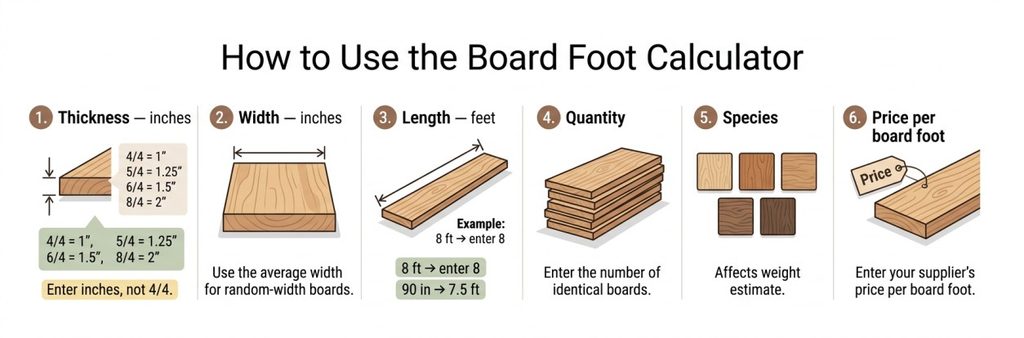
- Enter the thickness in inches. Thickness is the smallest dimension of the board. Hardwood is often labeled in quarters: 4/4 is 1 inch, 5/4 is 1.25 inches, 6/4 is 1.5 inches, and 8/4 is 2 inches. Enter the decimal inch value, not the quarter label. Common mistake: entering “4” for 4/4 stock.
- Enter the width in inches. This is the face measurement across the board. For rough or random-width boards, use the average width, or calculate each board separately.
- Enter the length in feet. Length is the one dimension entered in feet. An 8-foot board is entered as 8, not 96. If you measured in inches, divide by 12 first (a 90-inch board is 7.5 feet).
- Enter the quantity. This is the number of identical boards. If your boards differ in size, run separate calculations and add the totals.
- Choose a species. Hardwood or softwood species only affects the weight estimate, because density differs between woods.
- Enter the price per board foot. Use the price your supplier quotes per board foot. If a supplier quotes per piece or per linear foot, convert that to a per-board-foot price first so comparisons are fair.
Which dimensions to enter depends on how the wood is sold. Hardwood is generally sold on rough thickness in quarters. Softwood dimension lumber, such as a 2×4, is generally figured on its nominal size when priced by the board foot, even though the real piece is smaller. Your supplier’s convention is the one to follow, so ask if you are unsure.
What the Results Mean
Total Board Footage is the number your supplier will bill against. Board Feet Per Single Piece helps you check one board against a tag or quote before multiplying.
Total Linear Footage is the combined length of all boards, regardless of thickness or width. It is useful for trim, molding, and any material sold by the running foot.
Surface Face Area is the area of one face of the board (width times length), totaled across all pieces. It tells you how much surface you can cover, for example when planning a tabletop or panel glue-up.
Total Estimated Weight is the volume of wood multiplied by an average density for the chosen species. Use it to judge transport, handling, or shipping. Real weight varies with moisture content, so treat it as an approximation.
Estimated Material Cost (Net) is total board feet multiplied by your price per board foot. It assumes you use every inch of what you buy.
Recommended Order Cost (+15% waste) is the net cost multiplied by 1.15. It allows for trimming, defects, and cutting mistakes, which is why it is the better number for a purchase budget.
The Board Foot Formula
One board foot is the volume of a board 1 foot long, 12 inches wide, and 1 inch thick, which equals 144 cubic inches.
Board Feet = (Thickness × Width × Length) ÷ 12
Where:
- Thickness = board thickness in inches
- Width = board width in inches
- Length = board length in feet
If you measure all three in inches, use this version instead: Board Feet = (Thickness × Width × Length) ÷ 144
Both give the same answer. Mixing them up is the most common way to get a result that is 12 times too big or too small. The formula measures volume, so it works for any solid rectangular piece. It does not tell you how much of that volume is usable if the board is warped, has wane or knots, or will be cut into small parts.
Worked Example
Say you are buying 2 boards, each 1 inch thick, 6 inches wide, and 8 feet long, at $6.50 per board foot.
- Board feet per piece: (1 × 6 × 8) ÷ 12 = 48 ÷ 12 = 4 BF
- Total board feet: 4 × 2 = 8 BF
- Total linear feet: 8 × 2 = 16 ft
- Surface face area: 6 in ÷ 12 = 0.5 ft wide, so 0.5 × 8 = 4 sq ft per board, or 8 sq ft total
- Net material cost: 8 × $6.50 = $52.00
- Recommended order cost: $52.00 × 1.15 = $59.80
For weight, the calculator uses the density of the species you pick. As an illustration only, if a wood weighed 40 lb per cubic foot, 8 board feet is 8 ÷ 12 = 0.667 cubic feet, so the weight would be about 26.7 lb. Your result will differ with the species. So, you would budget about $59.80 and plan to buy roughly 9.2 board feet, since 8 × 1.15 = 9.2.
When the Calculator Helps
Pricing a project. Add up the board feet in your plan, then multiply by the price to see whether the materials fit your budget.
Comparing suppliers. One-yard prices per board foot, another per piece. Converting both to board feet shows which is cheaper.
Checking a quote or receipt. If a bill lists board feet, run the dimensions through the calculator to confirm the total.
Choosing thickness. Seeing how the board footage changes between 4/4 and 5/4 stock helps you decide whether the extra thickness is worth the cost.
Planning transport. The weight estimate tells you whether a load is manageable in a car, truck bed, or trailer.
How much wood should you buy. It helps you estimate how much wood and lumber you actually need for your project. Check out our complete guide: How Much Wood Should You Buy for a Furniture Project?
Common Mistakes
- Entering length in inches. The length field expects feet. A 96 in board entered as 96 will be off by a factor of 12.
- Using the quarter label as thickness. 4/4 means 1 inch. Enter 1, not 4.
- Using actual dimensions when the seller uses nominal. A softwood 2×4 measures about 1.5 by 3.5 inches. Figured nominally, an 8-foot piece is 5.33 BF. Figured on actual size, it is 3.5 BF. That is a large gap, so match the seller’s method. Or check the SPIB (Southern Pine Inspection Bureau) explanation about nominal vs. actual lumber sizes.
- Forgetting quantity. Per-piece board feet is not the total.
- Buying exactly the calculated amount. The net cost assumes zero waste. Use the +15% figure for ordering.
Board Feet vs. Linear Feet vs. Square Feet
These measure different things. Linear feet count length only, so an 8-foot board is 8 linear feet whether it is a 1×4 or a 2×12. Square feet measure area, and board feet measure volume. Two boards of the same length can have very different board footage if their thickness or width differs. Use linear feet for trim priced by the run, square feet for surface coverage, and board feet for solid lumber priced by volume.
Accuracy, Assumptions, and Limitations
The calculator applies the standard volume formula, so the board footage is only as accurate as the measurements you enter. It assumes a perfectly rectangular board with uniform thickness and width.
Some things it does not account for:
- Rounding. Suppliers often round each board, or the whole order, to the nearest tenth or whole board foot, so a bill may differ slightly from the calculator.
- Waste and defects. Knots, checks, wane, and cutting losses reduce usable wood. The 15% allowance is a general planning figure, not a guarantee. Complex projects or lower grades may need more.
- Surfacing losses. Rough lumber loses thickness and width when planed. Buy on rough size, but plan the project on finished size.
- Weight. It uses a typical density per species. Green, kiln-dried, and air-dried wood weigh differently, and individual boards vary.
- Supplier conventions. Grading, tally rules, and rounding differ between mills and yards. Confirm with your supplier when a total matter.
Treat the cost and weight outputs as estimates and the board footage as a measurement-based calculation.
Practical Tips
- Measure thickness at several points on rough stock. Boards are rarely uniform, and thickness has the largest effect on the total.
- Use the average width for tapered or random-width boards. Measure at both ends and the middle.
- Run your cut list first. Board footage tells you what to buy, but the parts you need decide how much of it is usable. The Cut List Calculator helps you check that before ordering.
- Round the order up. Order in whole boards or the smallest increment your supplier sells, not the exact decimal.
- Compare price per usable board foot. A cheaper lower grade can cost more once defects are cut away.
Reference Table: Board Feet per Piece by Nominal Size
Board feet = (nominal thickness × nominal width × length in feet) ÷ 12.
| Nominal Size | 8 ft | 10 ft | 12 ft |
| 1 × 4 | 2.67 | 3.33 | 4.00 |
| 1 × 6 | 4.00 | 5.00 | 6.00 |
| 1 × 8 | 5.33 | 6.67 | 8.00 |
| 1 × 10 | 6.67 | 8.33 | 10.00 |
| 1 × 12 | 8.00 | 10.00 | 12.00 |
| 2 × 4 | 5.33 | 6.67 | 8.00 |
| 2 × 6 | 8.00 | 10.00 | 12.00 |
| 2 × 8 | 10.67 | 13.33 | 16.00 |
Hardwood thickness in quarters: 4/4 = 1 in, 5/4 = 1.25 in, 6/4 = 1.5 in, 8/4 = 2 in.
Frequently Asked Questions
How many board feet are in a 2x4x8?
Using nominal size, 5.33 BF. Using actual size (1.5 × 3.5 in), 3.5 BF. Which applies depends on how the seller measures.
How many board feet are in a cubic foot?
12. One board foot is 144 cubic inches, and a cubic foot is 1,728 cubic inches.
Why is my supplier’s total slightly different from mine?
Usually rounding, or a different convention for measuring rough or random-width boards.
Do I use the finished size or the rough size?
For buying, the size the supplier measures, which for hardwood is typically the rough size. For project planning, the finished size, since planning removes material.
What if my boards have different sizes?
Calculate each size separately and add the results.
Is the weight result exact?
No. It is an estimate based on species density, and moisture content changes the real weight.
Should I order the net amount or the waste-adjusted amount?
Order the waste-adjusted amount unless your plan has almost no cutting loss.
Related Tools
If you need to estimate lumber for framing or a larger build, use the Lumber Calculator. If you want to work out how parts fit onto your boards before you buy, use the Cut List Calculator. And related more calculator- Construction .