
The Pool Volume Calculator estimates how many gallons (or liters) of water your pool needs. Enter your pool’s shape and dimensions to get an estimate.
This calculator supports rectangular, round, oval and L-Shape pools. Pick the shape that matches your pool, enter the required dimensions, and it returns the estimated volume in the units you choose.
The output shows estimated volume typically in gallons, with other units such as liters, cubic feet, or cubic meters available depending on what you select. Only use the units the tool actually offers; if you switch unit’s mid-calculation, re-enter your measurements in the new unit rather than mixing them.
Table of Contents
How to Use the Pool Volume Calculator
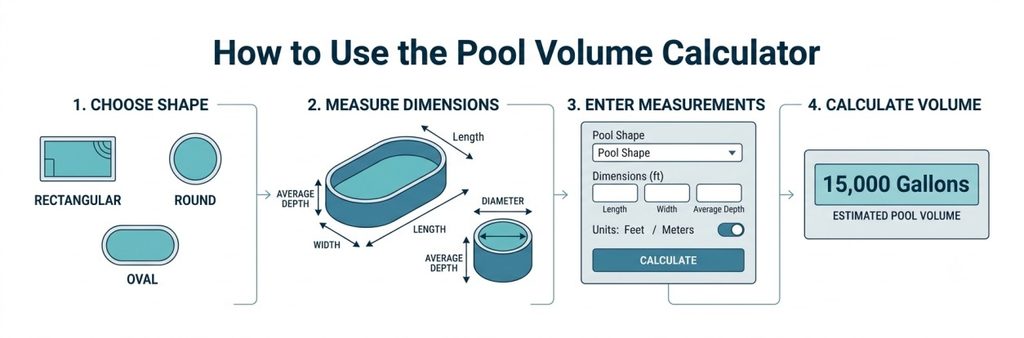
Step 1: Choose the pool shape. Shape determines which formula the calculator applies. A rectangular pool is calculated differently from a round or oval one, so picking the wrong shape will throw off the result even if your measurements are perfect.
Step 2: Enter the measurements. Each shape asks for different inputs length and width for a rectangle, diameter for a circle, length and width again (differently) for an oval. Enter the actual water dimensions, not a nominal or advertised size.
Step 3: Enter the average depth. Most pools aren’t a uniform depth from end to end. The calculator needs a single average depth figure to compute volume, so this step matters more than it looks more on estimating it below.
Step 4: Select the Pump Turnover Target. Choose the Pump Turnover Target hours to now Required Pump Flow Rate.
Step 5: Calculate the volume. The result is the estimated water volume for the shape and dimensions entered a geometric estimate, not a measurement of the actual water currently in your pool.
What Measurements Do I Need?
Rectangular pool
- Length
- Width
- Average depth
Round pool
- Diameter (distance straight across the pool through its center)
- Average depth
Don’t confuse diameter with radius. Radius is the distance from the center to the edge half the diameter. If you measure from the edge to the middle, double that number before entering diameter, or check whether the calculator asks for radius instead.
Oval pool
- Length (the longest measurement, end to end)
- Width (the widest measurement, side to side)
- Average depth
Follow the calculator’s own measurement instructions for oval pools, since “length” and “width” can be defined slightly differently between tools.
Above-ground pool
The same volume principles apply shape, dimensions, average depth. The one thing to watch for: measure the actual water dimensions and depth rather than assuming the pool holds its printed nominal size. Manufacturer-stated capacities are often based on a specific fill level or an idealized version of the pool’s dimensions, and can differ from what’s actually in the pool once it’s set up and filled.
How to Measure a Pool Correctly
A few habits make a real difference in accuracy:
- Measure the water, not the structure. Outside wall dimensions can overstate the pool’s actual interior size, especially with thick-walled above-ground pools.
- Measure actual water depth, not wall height. Pools are rarely filled exactly to the top, and wall height alone will overestimate volume.
- If the bottom slopes, measure both the shallow end and the deep end and use those to estimate an average don’t just use the deepest point.
- Watch for radius vs. diameter on round pools; using radius where diameter is expected (or vice versa) will throw the result off by roughly 4x.
- Keep units consistent. Measure everything in feet or everything in meters don’t mix.
- Account for unusual features like steps, benches, or tanning ledges by noting that they reduce the true volume below what a simple shape formula predicts.
How Pool Gallons Are Calculated
For a rectangular pool, the underlying formula is: Volume = length × width × average depth
This gives volume in cubic feet (if you measured in feet) or cubic meters (if you measured in meters). To convert that into gallons, the calculator multiplies by a standard conversion factor: 1 cubic foot = 7.48052 U.S. gallons
This is the U.S. gallon (231 cubic inches), which is what nearly all U.S. pool and chemical dosing references use. It’s a different, smaller unit than the Imperial gallon used in the UK, so if you’re comparing figures from a UK source, don’t assume the two-gallon figures are interchangeable. For metric measurements, 1 cubic meter = 1,000 liters, with no separate conversion factor needed.
Shape-Specific Calculations
Rectangular Pool Volume
- Formula: Volume (ft³) = length × width × average depth Gallons: Volume (ft³) × 7.48052
- Example: A 32 ft × 16 ft pool with an average depth of 5 ft: 32 × 16 × 5 = 2,560 ft³ 2,560 × 7.48052 ≈ 19,150 gallons
Round Pool Volume
Round pools are cylinders, so the formula uses the area of a circle:
- Formula: Volume (ft³) = π × radius² × average depth (radius = diameter ÷ 2)
- Example: A round pool with a 24 ft diameter (radius = 12 ft) and average depth of 4.5 ft: π × 12² × 4.5 = π × 144 × 4.5 ≈ 2,035.75 ft³ 2,035.75 × 7.48052 ≈ 15,229 gallons
Oval Pool Volume
An oval pool isn’t mathematically identical to a rectangle it’s closer to an ellipse. The calculator models it as an ellipse, using half the length and half the width as the two:
- Formula: Volume (ft³) = π × (length ÷ 2) × (width ÷ 2) × average depth. This is itself a simplification most oval pools aren’t a perfect ellipse either, so treat the result as a solid estimate rather than an exact figure.
- Example: An oval pool 20 ft long, 12 ft wide, with an average depth of 4.5 ft: π × 10 × 6 × 4.5 ≈ 848.23 ft³ 848.23 × 7.48052 ≈ 6,345 gallons
Worked Examples
- Example 1. Rectangular pool Dimensions: 32 ft × 16 ft, average depth 5 ft Calculation: 32 × 16 × 5 = 2,560 ft³ Gallons: 2,560 × 7.48052 ≈ 19,150 gallons
- Example 2. Round pool Diameter: 24 ft (radius 12 ft), average depth 4.5 ft Calculation: π × 12² × 4.5 ≈ 2,035.75 ft³ Gallons: 2,035.75 × 7.48052 ≈ 15,229 gallons
- Example 3. Oval pool Length: 20 ft, width: 12 ft, average depth 4.5 ft Calculation: π × 10 × 6 × 4.5 ≈ 848.23 ft³ Gallons: 848.23 × 7.48052 ≈ 6,345 gallons
Why Knowing Your Pool’s Gallons Matters?
- Filling the pool. knowing volume helps estimate how much water (and time, given your fill rate) it’ll take.
- Chemical dosing. most pool chemical products are dosed per gallon or per thousand gallons; getting the volume right matters for getting the dose right. Always follow the product label and manufacturer instructions for actual dosing don’t rely on general dosing rules without checking the label. Best way to follow CDC guidance on pool chemical safety.
- Draining and refilling. useful for budgeting water cost and time for a full or partial drain.
- Filtration and pump sizing. pump and filter recommendations are often based on turning over your pool’s total volume within a certain number of hours.
- Comparing water usage. useful if you’re tracking evaporation, leaks, or usage over a season.
How to Estimate Gallons for an Irregular Pool
If your pool doesn’t match a rectangle, circle, or oval an L-shape, a freeform design, a pool with an attached spa the calculator’s standard shapes won’t capture it directly. A practical workaround:
- Mentally divide the pool into simpler sections (for example, a rectangular section plus a smaller round section).
- Measure each section separately, including its own average depth.
- Calculate the volume of each section using the appropriate shape formula.
- Add the section volumes together for a total estimate.
This produces an approximation, and the more irregular the shape, the more it will depart from the actual volume. If your calculator doesn’t have a way to combine multiple shapes, you’ll need to run each section separately and add the results yourself.
Pool Volume Units
Depending on what the calculator supports, results are shown in:
- U.S. gallons– the standard unit for U.S. pool chemical dosing and fill estimates
- Liters– common outside the U.S., or for metric-based chemical products
- Cubic feet– the direct output of the geometric formula before gallon conversion
- Cubic meters– the metric equivalent of cubic feet
Stick to one measurement system for all your inputs don’t measure length in feet and depth in meters. If you need the result in a different unit than what you measured in, convert your inputs first rather than mixing systems mid-calculation.
Frequently Asked Questions
How do I calculate how many gallons my pool holds?
Multiply length × width × average depth to get cubic feet (for a rectangular pool), then multiply by 7.48052 to convert to U.S. gallons. Round and oval pools use different formulas based on their shape see the shape-specific sections above.
How do I calculate the volume of a round pool?
Use π × radius² × average depth to get cubic feet, then multiply by 7.48052 for gallons. Radius is half the diameter.
How do I calculate the volume of an oval pool?
Oval pools are modeled as an ellipse: π × (length ÷ 2) × (width ÷ 2) × average depth, converted to gallons the same way. This is an approximation, since most oval pools aren’t a perfect ellipse.
How do I calculate an above-ground pool’s gallons?
Use the formula matching its actual shape (usually round or oval), based on the pool’s real water dimensions and depth not the size printed on the box.
Should I use average depth?
Yes, if the pool’s depth varies at all. Using only the deepest or shallowest point will over- or underestimate the volume.
What’s the difference between pool capacity and actual water volume?
Capacity is often a manufacturer’s nominal figure; actual water volume depends on your pool’s real dimensions and current fill level. A geometric estimate based on your own measurements is usually more useful for maintenance purposes.
How accurate is a pool volume calculator?
It’s an estimate based on a geometric model of the shape you select. Features like steps, slopes, and curves that aren’t captured in the inputs will cause the estimate to drift from the true volume.
How do I measure a pool with a sloped bottom?
Measure the depth at the shallow end and the deep end, then estimate a reasonable average between them, weighted toward whichever depth covers more of the pool’s area.
How do I convert pool volume to gallons?
Multiply the volume in cubic feet by 7.48052 for U.S. gallons or convert cubic meters to liters by multiplying by 1,000.
Can I calculate the volume of an irregular pool?
Not directly with a single shape formula. Break the pool into simpler sections, calculate each one separately, and add the results together for an approximate total.
Related Tools
Pool Chemical Calculator – Calculate chemical dosage for your pool.