
Generate a random Pokémon or full team by generation, type, and rarity. Includes artwork, type, ability, and team coverage. Free and instant.
About Random Pokémon Generator
Trying to pick a Pokémon at random for a Nuzlocke run, a fan team build, a classroom game, or just to settle an argument about which starter is “canonically” the best is harder than it sounds once you actually try to do it fairly. Flipping through a Pokédex or scrolling a list in your head isn’t random; you’ll always gravitate toward the same dozen favorites. This tool solves that by pulling from the full pool of Pokemon (or whatever slice of it you choose) and handing back a genuinely random pick, or a full randomized roster if you need one.
Before you use it, it helps to know what you want out of the result: a single Pokémon, a themed team, a starter-only pull, or a pool restricted to one region or type. The generator’s filters map directly onto those choices, so the more specific you are with the inputs, the more useful the output.
How to Use the Random Pokémon Generator
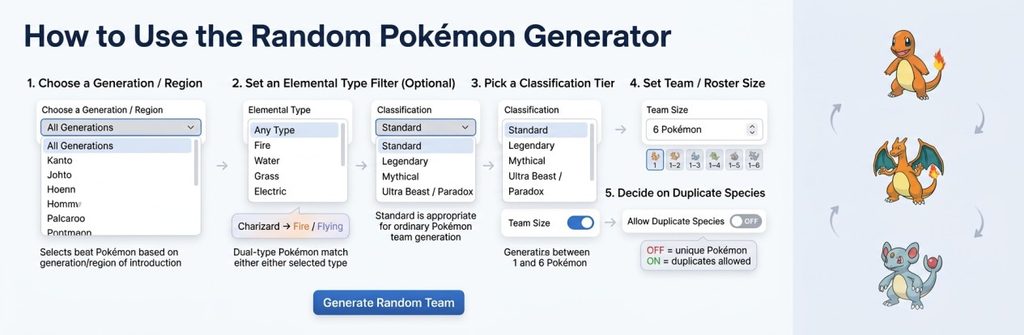
- Choose a Generation / Region. This narrows the pool to Pokémon introduced in a specific region Kanto, Johto, Hoenn, and so on. Leave it on “All Generations” if you want the full National Pokédex in play. A common mistake here is assuming “Generation” means “games you own” rather than “the region where a Pokémon was first introduced” a Pokémon from Kanto can still appear in a modern game, but it’s still counted as Gen 1 for this filter.
- Set an Elemental Type Filter (optional). If you want only Fire-types, or only Water-types, set it here. If a Pokémon has two types (like Charizard, Fire/Flying), it will match the filter if either of its types fits worth knowing if you’re trying to build a mono-type team and end up with a Pokémon that’s only partially the type you wanted.
- Pick a Classification Tier. This controls whether Legendary and Mythical Pokémon (and, depending on how you define it, Ultra Beasts or Paradox forms) are included, excluded, or the only thing generated. Leaving this on “Standard” keeps the pool to ordinary, catchable Pokémon useful if you’re building a team for casual or competitive play rather than a legendary-hunting scenario.
- Set Team / Roster Size. Enter how many Pokémon you want generated at once 1 for a single pull, up to 6 for a full team. This is the most common source of confusion: people expect “roster size 6” to mean 6 unique Pokémon, which only holds if duplicates are turned off (see the next step).
- Decide on Duplicate Species Allowed. Toggle this to “No” if you want every Pokémon in the result to be a different species the standard choice for team-building. Toggle it to “Yes” if you’re fine seeing the same species more than once, which matters for smaller filtered pools (for example, generating a 6-Pokémon team from a single-type, single-generation filter that only has 4 qualifying Pokémon without duplicates allowed, that request simply can’t be fulfilled).
- Generate. The tool returns your Pokémon (or team), each with its official artwork, type(s), and one of its native abilities.
Understanding the Results
- Random Pokémon (with photo): The species selected, shown with its artwork so you can identify it immediately rather than working from a name alone. And Every time you click generate you will get unique Pokemon.
- Type & Ability: Every Pokémon has one or two types, which determine its strengths and weaknesses in battle, and a pool of possible abilities. The result shows one valid ability for that species not necessarily the only one it can have, since many Pokémon have two or three possible abilities depending on the individual.
- Roster Size: A confirmation of how many Pokémon you asked for, shown alongside the results so it’s easy to check the output matches the request.
- Generation Filter: Shows which region(s) the pull was drawn from, so you know at a glance whether you’re looking at an all-generations result or a restricted one.
- Type Coverage: For team results, this summarizes the types represented across your whole roster useful for spotting a team that’s accidentally weak to a specific type because three of your six picks share a common weakness.
How the Generator Selects a Pokémon
There’s no complex formula here the underlying logic is simple, and it’s worth understanding because it explains why certain results feel more or less likely. Where the filtered pool is every species that satisfies your Generation, Type, and Classification Tier settings at the same time (not any one of them alone).
Selection logic: Probability of any one species being picked = 1 ÷ (number of species in the filtered pool)
This means an unfiltered, all-generations, standard-tier pull draws from over 1,000 possible species, so any single species is picked at random with roughly equal odds. But once you apply filters, the pool shrinks sometimes to a handful of Pokémon, and each remaining one becomes proportionally more likely to appear. A single-type filter on a rare type in one generation might leave you with only 3–4 eligible Pokémon, so don’t be surprised if you see the same species come up more than once across several pulls in a row. That’s not a bug; it’s what a small sample size looks like.
Worked Example
Say you set: Generation = Kanto only, Type = Fire, Classification = Standard, Roster Size = 1, Duplicates = N/A (single pull).
The Kanto Pokédex has three standard-tier Fire-type species: Growlithe, Ponyta, and Vulpix (their evolutions Arcanine, Rapidash, and Ninetales are also Fire-type and standard-tier, so the real eligible pool is six species once evolutions are included).
Pool size = 6. Probability of any one species being selected = 1 ÷ 6 ≈ 16.7%
If the generator returns Vulpix, that’s simply one outcome from a six-way draw run it again and you have the same 1-in-6 shot at any of the six, Vulpix included.
Common Situations Where This Tool Helps
- Nuzlocke and self-imposed challenge runs, where players want a randomized starter or catch list instead of hand-picking favorites.
- Building a themed fan team a mono-type squad, a “first generation only” nostalgia team, or a legendary-only lineup.
- Tabletop or classroom games that use Pokémon as prompts and need a fair, unbiased way to assign one to each player.
- Breaking a stalemate when a group can’t agree on which Pokémon to use for a fan art request, a drawing challenge, or a team-building debate.
- Testing “what if” team compositions without the bias of always reaching for the same well-known Pokémon.
Common Mistakes
- Requesting more unique Pokémon than the filtered pool can supply. If your filters leave only 4 eligible species but you ask for a 6-Pokémon team with duplicates off, the request can’t be completed as specified widen a filter or allow duplicates.
- Assuming “Generation” filters by game version rather than by a Pokémon’s origin region. A Pokémon that first appeared in Gen 3 still counts as Gen 3 even if you’re thinking of it from a later game.
- Forgetting that dual-type Pokémon match a single-type filter on either type. If you filter for “Electric” expecting a mono-Electric team, you may still get a Pokémon like Rotom (Electric/Ghost) or Emolga (Electric/Flying) in the results.
- Treating the “Classification Tier” filter as covering competitive tiers (like OU/UU) instead of rarity tiers (standard/Legendary/Mythical). They’re unrelated systems this tool only controls the latter.
Regional Generation vs. Classification Tier
These two filters are often confused because they both sound like they’re about “how special” a Pokémon is, but they control different things. Generation is purely about origin which region and game era a Pokémon was introduced in. Classification Tier is about rarity and story role whether a Pokémon is an ordinary, obtainable species or a one-of-a-kind Legendary or Mythical. A Pokémon can be old and ordinary (a Gen 1 Rattata), old and legendary (a Gen 1 Mewtwo), new and ordinary, or new and legendary the two filters are independent, and combining them is how you narrow down to something specific, like “only Legendary Pokémon from Generations 1–3.”
Accuracy, Assumptions, and Limitations
The pokemon generator draws from a fixed 1020+ Pokémon type, maintained species list, so results are only as current as that list if a new game introduces additional Pokémon, the pool is updated to include them, but there can be a short lag after an official release. Ability results show one legitimate ability for the species, not an exhaustive list of every ability that species can have, since several Pokémon carry two or three possible abilities that vary by individual.
Regional variant forms (like Alolan or Galarian forms) and evolutions are treated as belonging to the same species line but may or may not appear as separate entries depending on your filter settings if you need a specific form, it’s worth generating a few times and checking the result rather than assuming one form is guaranteed. Finally, “random” here means each eligible Pokémon has an equal chance of selection within the filtered pool it does not weight by popularity, competitive viability, or how often a Pokémon appears in games, so don’t read outcome patterns as reflecting anything beyond chance.
Practical Tips
- If you want a fair team rather than a themed one, leave Generation and Type filters open and only set Roster Size and Duplicates narrowing filters concentrates randomness into a smaller pool and makes outcomes more predictable, not less.
- When building a mono-type team, double-check the Type Coverage output afterward a dual-type Pokémon can sneak in a second type you didn’t intend to include.
- If a generation-restricted pull keeps returning the same few Pokémon, that’s a sign your filtered pool is small widen the Generation range or turn off the Type filter to get more variety.
- For classroom or group use, generate the full roster in one pull rather than one Pokémon per person separately this keeps duplicate handling consistent across the whole group instead of person-by-person.
Reference: Pokémon Generations by Region
| Generation | Region | Approx. National Dex Range |
| Gen 1 | Kanto | #1–151 |
| Gen 2 | Johto | #152–251 |
| Gen 3 | Hoenn | #252–386 |
| Gen 4 | Sinnoh | #387–493 |
| Gen 5 | Unova | #494–649 |
| Gen 6 | Kalos | #650–721 |
| Gen 7 | Alola | #722–809 |
| Gen 8 | Galar | #810–905 |
| Gen 9 | Paldea | #906–1025 |
You can see every individual Pokémon (not just the ones grouped by generation) by browse the full National Pokédex, where all Pokémon are shown in one complete list.
Frequently Asked Questions
Can I generate a starter Pokémon only?
Yes, set the Classification Tier or a dedicated starter filter if your tool exposes one; this restricts the pool to the three starters available at the beginning of each region’s main games (typically one Grass, one Fire, and one Water type per generation).
Why did I get the same Pokémon twice in one team when I turned duplicates off?
That shouldn’t happen if it does, check whether your filters (Generation + Type + Tier combined) left a pool too small to guarantee unique results, which can cause the generator to fall back on repeats rather than fail the request.
Does the tool include Mega Evolutions or Gigantamax forms?
That depends on how the Classification Tier and species list are configured; these forms are typically treated as alternate forms of an existing species rather than separate entries, so they may not appear as a standalone pull.
Is the generated team good for competitive battling?
Not necessarily this tool optimizes for randomness, not competitive viability, so a randomly generated team may include Pokémon that are weak in competitive formats. It’s built for variety and fun, not tournament preparation.
Can two people get the same random result?
Yes. Each generation is an independent, equal-chance draw from the pool there’s nothing that prevents the same Pokémon coming up for different people, especially with a small filtered pool.
Related Tools
If you’re randomizing more than just Pokémon, the Random Name Generator and Random Number Generator on this site work the same way pull a fair, unbiased result from a defined pool, whether that’s names for a character or numbers for a raffle. If you’re just after stylized text for a team name or fan post, the Fancy Font Generator and Cool Text Generator can dress up whatever you generate here.