
Use this lumber calculator to turn a shopping list of boards into numbers you can order from. Enter the required inputs and get the order quantity, board feet, linear feet, weight and cost.
Lumber Calculator
Pick a nominal size such as 2×6, enter the stick length and how many pieces your plan calls for, add a waste buffer, and it returns the recommended order, total board-foot, total linear footage, the actual dressed cross-section, an estimated bundle weight, and an estimated bundle cost.
It suits homeowners planning a deck, fence, or wall framing, contractors pricing a materials list, and anyone who wants to know what a stack of boards will weigh before it goes on a truck. Before you start, you need three things: the board size, the length you plan to buy, and how many pieces your plan requires. A unit price makes the cost result useful.
How to Use the Lumber Calculator
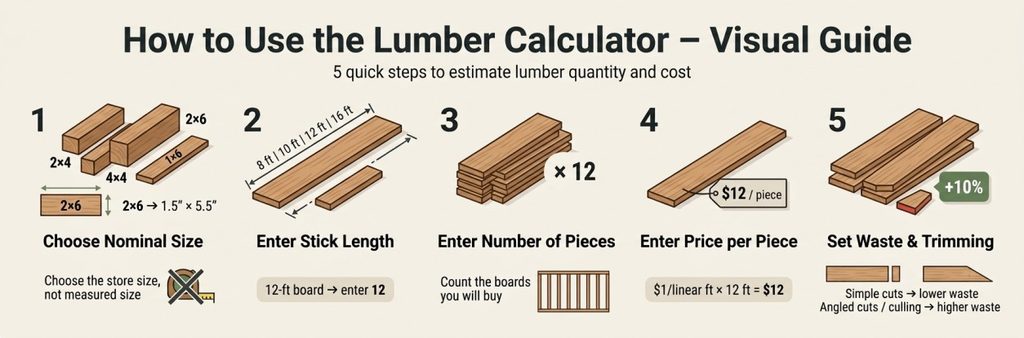
- Choose the nominal size. This is the name on the label, such as 2×4, 2×6, 4×4, or 1×6. The calculator shows the actual dressed size next to it. A 2×6 is not 2 by 6 inches. Once it has been dried and planed, it measures about 1.5 by 5.5 inches. Pick the size by its store name, not by a tape measure.
- Enter the stick length in feet. This is the length of each board as sold (8, 10, 12, 16 feet, and so on), not the length of the cuts you need from it. Stock lengths differ between suppliers, so check what your yard actually carries. The usual mistake is entering a cut length, such as a 3-foot deck rail, when the board you’ll buy is a 12-footer.
- Enter the number of pieces. This is the count of boards your plan needs, before any extra for waste. If you have a cut list, count the sticks after you’ve fit your cuts onto stock lengths. If you don’t, work it out from your layout. For example, studs at 16 inches on center need about 0.75 studs per foot of wall, plus one to close the run, plus extras for corners, openings, and plates.
- Enter the price per piece. Use the price for one stick at the length you selected. Lumber is usually priced per piece, but some yards quote per linear foot or per board foot, so convert first. A 12-foot board priced at $1.00 per linear foot is $12.00 per piece.
- Set the waste and trimming buffer. This is a percentage added on top of your piece count to cover bad boards, miscues, and end trimming. Straight framing with simple cuts needs less. Angled cuts, decking patterns, or a stack you’ll have to cull will need more.
Understanding the Results
Exact Pieces Needed is the count your plan requires with no cushion. Recommended Order adds your buffer and rounds up to a whole board, since you can’t buy 0.4 of a stick.
Total Nominal Board Feet measures wood volume using the nominal size. One board foot is 144 cubic inches of nominal volume, the equivalent of a board 1 inch thick, 12 inches wide, and 1 foot long. This is the figure to use when comparing prices to yards or mills that sell by the board foot.
Total Linear Footage is the sum of all the board lengths laid end to end. Use it if your supplier prices by the foot, or to sanity-check a plan.
Actual Dressed Cross-Section is the real thickness and width of one board after milling, which is the size that matters for fit, spans, and measurements on the job.
Estimated Bundle Weight is a planning figure for hauling and handling. Weight depends heavily on species and moisture content, so treat it as an approximation, not a scale reading.
Estimated Bundle Cost is the piece count multiplied by your price per piece. Check whether the figure reflects the exact count or the recommended order, so you know which number to budget.
The Formulas
Nominal board feet for the whole order: BF = (T × W × L ÷ 12) × N
Where T is nominal thickness in inches, W is nominal width in inches, L is stick length in feet, and N is the number of pieces.
Recommended order: Order = round up of [ N × (1 + waste ÷ 100) ]
Total linear feet: Linear feet = L × N
Weight: Weight = (actual thickness × actual width × L × 12) ÷ 1,728 × density × N
The 1,728 converts cubic inches to cubic feet, and density is in pounds per cubic foot. It varies by species and moisture, so the calculator’s weight is an estimate based on its assumed density.
Cost: Cost = pieces × price per piece
One convention to be aware of: board feet use the nominal size, while weight uses the actual size. That’s deliberate. Board feet are a pricing and trade unit, and the wood physically present is the smaller actual size.
Worked Example
Say you’re framing a shed wall section and your plan needs 40 pieces of 2×6, 12 feet long. You allow a 10% buffer and the yard prices each stick at $9.50. For the weight, assume a density of 30 lb per cubic foot, which is only an illustration. Your calculator’s assumption may differ.
- Recommended order: 40 × 1.10 = 44 pieces
- Board feet per stick: 2 × 6 × 12 ÷ 12 = 12 BF
- Total nominal board feet: 40 pieces = 480 BF; the 44-piece order = 528 BF
- Total linear feet: 40 × 12 = 480 ft; the 44-piece order = 528 ft
- Actual cross-section: 1.5 × 5.5 in = 8.25 square inches
- Volume per stick: 8.25 × 144 in = 1,188 cubic inches = 0.6875 cubic feet
- Weight per stick: 0.6875 × 30 = 20.625 lb, about 20.6 lb
- Weight of 44 sticks: 44 × 20.625 = 907.5 lb
- Cost: 44 × $9.50 = $418.00 (or $380.00 for exactly 40)
So you’d order 44 boards, budget about $418, and plan on close to 900 pounds of wood in the load. That is worth knowing before you decide whether a pickup truck will cope.
Where the Calculator Helps
Framing and general building. Convert a wall or floor plan into a purchase order with a built-in cushion, then see what it will cost and weigh.
Decks. Joists, beams, and ledger boards are usually one or two sizes in a few lengths, which suits a piece-count calculation. Run each size separately and add the results.
Fences. Rails and posts are often the same nominal sizes repeated many times, so quantity and cost add up quickly. The weight figure helps you plan how many trips you’ll need.
Comparing quotes. Different suppliers quote per piece, per foot, or per board foot. Entering the same order in the calculator gives you comparable totals for each.
Checking a plan or an invoice. If a delivered bundle or a quote looks off, compare its board feet or piece count to the calculator’s numbers.
The calculator doesn’t work out how many studs or joists your design needs from its dimensions. You supply the piece count, and it does the volume, weight, and cost arithmetic from there.
Common Mistakes
- Entering the cut length, not the stick length. The tool needs the length of the board you’ll buy, since that determines cost and weight.
- Using actual dimensions for the size. Select the nominal name. The tool already knows the actual dimensions.
- Comparing board feet to linear feet. A 12-foot 2×6 is 12 board feet and also 12 linear feet, a coincidence of the 2×6 size. A 2×4 the same length is 8 board feet but still 12 linear feet.
- Forgetting to apply waste before comparing prices. If a quote covers an order with no cushion, add your buffer first so you don’t come up short on site.
- Entering a per-foot price as a per-piece price. Multiply by the stick length first.
- Treating the weight as exact. It’s fine for planning a load, not for checking a lifting limit to the pound.
Nominal vs. Actual Size
Nominal dimensions are the traditional names of the lumber, dating from when boards were sized before drying and planning. Actual dimensions are what you’d measure with a tape today. Board-foot math uses nominal, while fit and physical volume use actual. In the United States, these finished sizes aren’t set by each mill on its own. They come from the American Softwood Lumber Standard (PS 20), a voluntary product standard published by the National Institute of Standards and Technology.
Accuracy, Assumptions, and Limitations
This is an estimating tool, and the results are only as good as the inputs.
- Actual sizes are standard softwood dimensional sizes. Hardwood boards, rough-sawn lumber, and specialty stock may be different, and so may some engineered products.
- Weight is an estimate. It rests on an assumed density. Green or wet lumber can be substantially heavier than kiln-dried, and species varies too. Use the number to plan, not to certify a load.
- The buffer is a percentage, not a forecast. The right amount depends on the project, your cutting skill, and the quality of the stock you’re given.
- Prices are as entered. The tool doesn’t include tax, delivery, or bulk discounts.
- Stock lengths and grades vary by region and supplier. Confirm what’s available before you settle on a plan.
- Rounding. Order quantities round up to whole boards, so totals may differ slightly from a simple multiplication.
- It is not structural design. It doesn’t check spans, loads, or code requirements. For those, follow your local building code and your plans.
Practical Tips
Fit your cuts to stock lengths first. Two 5-foot pieces from a 10-foot board waste nothing, while two 5-foot pieces from a 12-footer waste 2 feet. Choosing stock lengths this way often reduces the piece count more than any buffer does. The Cut List Calculator is built for this.
Sort your list by size and run each separately. The calculator handles one size and length at a time, so a deck with three sizes needs three runs. Add up the totals afterwards.
Raise the buffer for crooked, cracked, or wet stock. Culling at the yard costs time; if you can’t cull, assume more waste.
Check the price basis. Ask whether a quote is per piece, per linear foot, or per board foot before entering it.
Use the weight to plan the trip. A few hundred pounds of framing lumber is manageable in a truck bed, but a large order can exceed a vehicle’s payload rating.
Reference Table: Common Sizes
Board feet are nominal, so they’ll match what a per-board-foot price quote implies. Board feet per 8-foot stick = T × W × 8 ÷ 12.
| Nominal size | Actual size (in) | Actual area (sq in) | BF per linear ft | BF per 8-ft stick |
| 1×4 | 0.75 × 3.5 | 2.625 | 0.333 | 2.67 |
| 1×6 | 0.75 × 5.5 | 4.125 | 0.5 | 4.00 |
| 2×4 | 1.5 × 3.5 | 5.25 | 0.667 | 5.33 |
| 2×6 | 1.5 × 5.5 | 8.25 | 1.0 | 8.00 |
| 2×8 | 1.5 × 7.25 | 10.875 | 1.333 | 10.67 |
| 2×10 | 1.5 × 9.25 | 13.875 | 1.667 | 13.33 |
| 2×10 | 1.5 × 11.25 | 16.875 | 2.0 | 16.00 |
| 4×4 | 3.5 × 3.5 | 12.25 | 1.333 | 10.67 |
Multiply the BF per linear foot by the stick length to get board feet per board, and by the piece count for the total.
Frequently Asked Questions
How many board feet are in a 2×6?
It depends on length. A 2×6 contains 1 board foot per linear foot, so an 8-foot piece is 8 BF and a 12-foot piece is 12 BF.
Why does a 2×4 measure 1.5 by 3.5 inches?
The nominal name refers to the rough size before drying and planing. The finished board is smaller.
Does the calculator work out how many studs or joists I need?
No. You enter the number of pieces from your plan or cut list, and it returns quantity with a buffer, volume, weight, and cost.
What waste percentage should I use?
It depends on the job. Simple, straight cuts need less, while angles, patterns, and crooked stock need more. The buffer is your judgment call, so use the calculator to see what different values do to the order and cost.
Are the board feet based on nominal or actual size?
Nominal. That’s the standard convention for pricing, and it’s why the figures don’t match the physical volume of the boards.
Is the weight accurate enough to plan a delivery?
It’s a reasonable estimate for planning a load. Wet or dense stock can weigh noticeably more, so leave yourself a margin.
Can I use it for hardwood?
It’s designed around standard dimensional lumber. For hardwood sold by the board foot in varied widths and thicknesses, the Board Foot Calculator is the better fit.
Related Tools
If you’re pricing lumber sold by the board foot or comparing species, use the Board Foot Calculator. If you’re working out how many boards a set of cuts requires from stock lengths, use the Cut List Calculator, then bring the resulting piece count back here for cost and weight. Check more Construction Calculators.