
This Wood cut list calculator tells you how many stock boards you need to buy to produce a set number of identical parts, and how each board will be divided.
Cut List Calculator
Enter the raw board length, your saw blade’s kerf, how much you trim off each end, the finished part length, and the number of parts. It returns boards required, parts per board, leftover offcut, and material yield.
It suits woodworkers, DIY builders, and contractors who cut many pieces of the same length, such as shelf cleats, stair blocking, fence pickets, or table aprons. Before you start, you need a tape-measure length for the stock, the finished length of the part, and your blade’s kerf.
How to Use the Wood Cut List Calculator
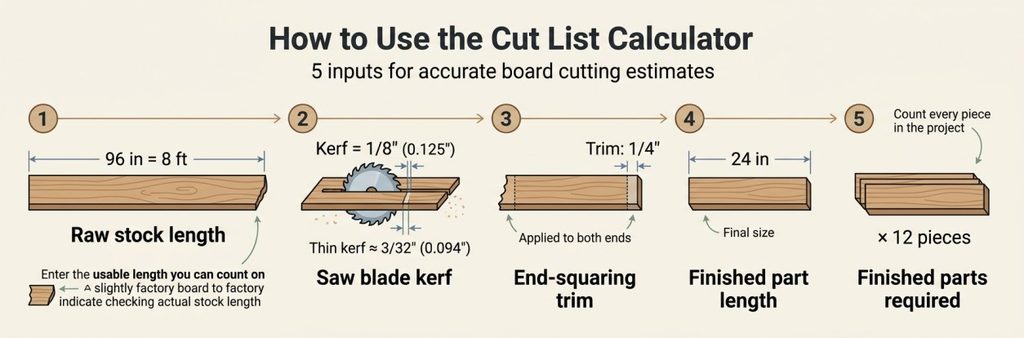
- Enter the raw stock length. This is the full length of the board as you buy it, such as 96 in for an 8 ft board. Measure a few boards from the rack, because lumber is sometimes cut slightly long. Enter the length you can count on.
- Enter the saw blade kerf. The kerf is the width of material your blade turns into sawdust with each cut. Full-kerf blades are commonly about 1/8 in (0.125). Thin-kerf blades are often about 3/32 in (0.094). Check the blade’s packaging or make a test cut and measure the slot. Convert fractions to decimals.
- Enter the end-squaring trim for each end. Factory ends are often rough, checked, or not square. Most people cut a little off each end first. Enter the amount removed from one end. The calculator applies it to both. If you don’t trim, enter 0.
- Enter the finished part length. Use the final length you need, not a rough length with extra margin. If you plan to sand or plane the ends afterward, add that allowance yourself.
- Enter the total finished parts required, counting every piece of that length in the whole project.
Use the same unit for every length field. The examples on this page use inches. The common slip is mixing feet and inches, for example 8 for the board and 22 for the part. The calculator would treat those as the same unit.
The Results Explained
Usable board length after trim is the raw length minus the trim from both ends. This is the length you actually have to cut parts from.
Finished parts per stock board is how many full-length parts one board yields once kerf is accounted for.
Stock boards required is the number of boards to buy, rounded up. You can’t buy 7.5 boards.
Total finished parts produced can exceed what you asked for. If each board yields 4 parts and you need 30, you buy 8 boards and end up with 32 parts. The extra ones are spares.
Total saw kerf loss (per board) is the material turned to sawdust on one board.
Offcut scrap left per board is what remains after the last part. Offcuts are often too short to use, but sometimes they are enough for a small part, so it is worth looking.
Material yield efficiency is the percentage of the boards you buy that ends up as finished parts. The rest is trim, kerf, and offcut.
The Formulas
U = L − 2T
n = floor( (U + k) ÷ (P + k) )
B = ceil( N ÷ n )
Parts produced = B × n
Kerf loss per board = (n − 1) × k
Offcut per board = U − (n × P) − ((n − 1) × k)
Yield % = (B × n × P) ÷ (B × L) × 100
Where:
- L = raw stock length
- T = trim removed from each end
- U = usable length after trim
- k = saw kerf
- P = finished part length
- n = parts per board
- N = total parts required
- B = boards required
Why (U + k) ÷ (P + k)? With n parts you make n − 1 cuts between them, so the requirement is n × P + (n − 1) × k ≤ U. Rearranged, that gives the expression above. The floor function rounds down, because you can’t get a fraction of apart from a board. These formulas apply when every part is the same length and comes from straight, solid stock. They don’t apply if you have several different part lengths to fit onto the same boards, or if you’re laying out flat sheets.
Worked Example
You are building a set of shelf supports. You need 30 pieces, each 22 in long, from 8 ft boards (96 in). You trim 1 in off each end, and your blade kerf is 0.125 in.
- Inputs: L = 96, T = 1, k = 0.125, P = 22, N = 30.
- Usable length: U = 96 − 2(1) = 94 in.
- Parts per board: n = floor((94 + 0.125) ÷ (22 + 0.125)) = floor(94.125 ÷ 22.125) = floor(4.254) = 4.
- Check: 4 × 22 = 88, plus 3 kerfs × 0.125 = 0.375, so 88.375 in used out of 94. It fits. A fifth part would need 110 + 0.5 = 110.5 in, which does not.
- Boards required: B = ceil(30 ÷ 4) = ceil(7.5) = 8.
- Parts produced: 8 × 4 = 32, so you get 2 spares.
- Kerf loss per board: 3 × 0.125 = 0.375 in.
- Offcut per board: 94 − 88 − 0.375 = 5.625 in.
- Yield: (8 × 4 × 22) ÷ (8 × 96) = 704 ÷ 768 = 91.67%.
- Accounting for one board: 2 in trim + 88 in parts + 0.375 in kerf + 5.625 in offcut = 96 in. That total matching the raw length is a quick way to confirm any result.
So, you would buy 8 boards, and each yield’s four 22 in shelf supports. If you counted only the 30 parts you needed, the yield would be 660 ÷ 768, about 85.9%, because two of the parts are spares.
Situations Where a Wood Cut List Calculator Helps
Buying lumber. Knowing you need 8 boards rather than “about 7” avoids a second trip to the store or a project stalled with 28 of 30 parts.
Choosing between board lengths. Run the same job with 8 ft and 10 ft boards. Sometimes the longer board yields an extra part and wastes less, even at a higher price per board.
Adjusting the part length. A part that is 1 in shorter can sometimes fit an extra piece per board. If your design has any flexibility, try a few lengths.
Checking a hand calculation. Kerf is the term people most often forget when working out a lumber cut list by hand.
Common Mistakes
Ignoring kerf. Kerf seems tiny, but it can change the count. Take four 24 in parts from a 96 in board with no trim. Without kerf it looks like four fit. With a 0.125 in kerf, you need 96 + 0.375 = 96.375 in, which is more than the board has. You get three.
Entering the trim for both ends. The trim field is for each end. If you cut 1 in off each end, enter 1, not 2.
Using a nominal or catalog length. A board sold as 8 ft may measure slightly over or under. Measure a few.
Entering fractions. Type 0.125, not 1/8. Convert 3/32 to about 0.094.
Using a rough length for the finished part. Enter the length you need after cutting, not a length with your own safety margin, or you will count the margin twice.
Reading spares as an error. Having more parts produced than required is normal, because boards come whole.
Board Cuts vs. Sheet Cuts
This tool works in one dimension: it divides a length of board into shorter lengths. A plywood cut list calculator that lays rectangles on a 4 × 8 sheet is a different problem, because it has to place parts in two dimensions. If you are cutting plywood panels, this calculator will not plan the layout. You can still use it for ripped strips of plywood, treating each strip like a board.
For the same reason, this is not a cut list optimizer in the sense of mixing several part lengths across boards to minimize waste. It calculates a single part length at a time. For a project with several lengths, run each length separately, then look at the offcuts to see if a leftover piece is long enough for a shorter part.
Accuracy, Assumptions, and Limitations
The result is a planning estimate. It assumes:
- Every board is the same length and free of defects.
- Every cut is straight, with the same kerf.
- Parts are all one length.
- Trim is the same on each end and on every board.
It does not account for knots, splits, warp, or crooked boards that force you to cut around a defect. It does not account for cuts that go wrong, or for angled cuts such as miters, which use more length than a square cut. It does not account for grain matching, where you choose the location of a part on the board for appearance.
Your saw’s real kerf may be slightly wider than the blade’s stated width, depending on tooth set and how the blade tracks. The result also assumes the stock length you entered is accurate. For lumber, add a few spare boards for defects. How many depends on the grade of the material and how picky you are about appearance. For background on how lumber behaves, including moisture and dimensional change, see the USDA Forest Products Laboratory’s Wood Handbook.
Practical Tips
- Measure the real kerf. Cut into a scrap piece and measure the slot with calipers or a tape. This is more reliable than the number printed on the blade.
- Cut a test board first. If your first result varies from the calculated figure, adjust kerf or trim and re-run.
- Look at the offcut figure. If offcut is nearly as long as a part, changing the part length by a small amount, or trimming less, may add one more part per board.
- Compare board lengths. Enter 8 ft, 10 ft, and 12 ft stock. Compare the boards required and yield, then the price.
- Cut all the parts from one board before moving on if you are trying to match grain or color.
Reference Table
Parts from one 96 in board with 0.5 in trim on each end (U = 95 in) and 0.125 in kerf.
| Part length (in) | Parts per board | Offcut (in) | Yield |
| 12 | 7 | 10.25 | 87.5% |
| 16 | 5 | 14.5 | 83.3% |
| 18 | 5 | 4.5 | 93.75% |
| 24 | 3 | 22.75 | 75% |
| 30 | 3 | 4.75 | 93.75% |
| 36 | 2 | 22.875 | 75% |
| 48 | 1 | 47 | 50% |
Notice the 48 in row. Two 48 in parts plus one kerf come to 96.125 in, and the usable board is only 95 in, so only one-part fits. A part length that looks like it should divide the board evenly often does not once trim and kerf are counted.
Frequently Asked Questions
Does the calculator include the kerf of the last cut?
It counts one kerf between each pair of neighboring parts. Confirm this matches your own way of cutting.
What kerf should I enter?
Use your blade’s actual kerf. About 1/8 in (0.125) is common for full-kerf blades and about 3/32 in (0.094) for thin-kerf blades. Measuring a test cut is more reliable.
Why are there more parts produced than I asked for?
Boards are bought whole. If each yield’s 4 parts and you need 30, you buy 8 boards and get 32.
Can I use it for plywood?
Only for strips cut along one dimension. It cannot lay out parts on a sheet.
Can I enter more than one part length?
No. Run the calculation for each length separately.
How many extra boards should I buy?
That depends on the material and how much of it has defects. The cut list calculator does not include a waste allowance.
Related Tools
To convert boards into volume and cost, use the Board Foot Calculator. To work out how many pieces of a nominal size to order for a project, try the Lumber Calculator.
Once you know how many boards the cut list calls for, the Board Foot Calculator can price them. And other Calculators.