
Enter/select the required details in the Conduit Fill Calculator to determine the appropriate conduit size.
About Electrical Conduit Fill Calculator
This conduit fill calculator shows how many wires can safely fit inside a conduit and whether your chosen conduit size meets the NEC maximum fill limit. Select the raceway type, trade size, wire insulation type, conductor size, and number of conductors. The tool returns the fill percentage and a compliance check, so you can see right away whether the conduit is big enough or you need to step up a size. It also shows how much usable capacity is left, which tells you how many more conductors you could add.
It’s useful to electricians planning a run, apprentices checking their work, estimators sizing conduit for a bid, and homeowners or DIYers who want to know whether one more circuit will fit in an existing pipe. Because it works both ways, you can start with a conductor count and find the smallest conduit that passes, or start with an existing conduit and see how many wires it can hold.
Have these on hand before you start: the type of conduit (EMT, PVC, RMC, and so on), its trade size, the insulation marking printed on the wire jacket (THHN, XHHW, and so on), the conductor gauge, and the total number of conductors that will share the conduit. Need a quick count by wire size? See the wire fill chart.
How to Use the Electrical Conduit Fill Calculator
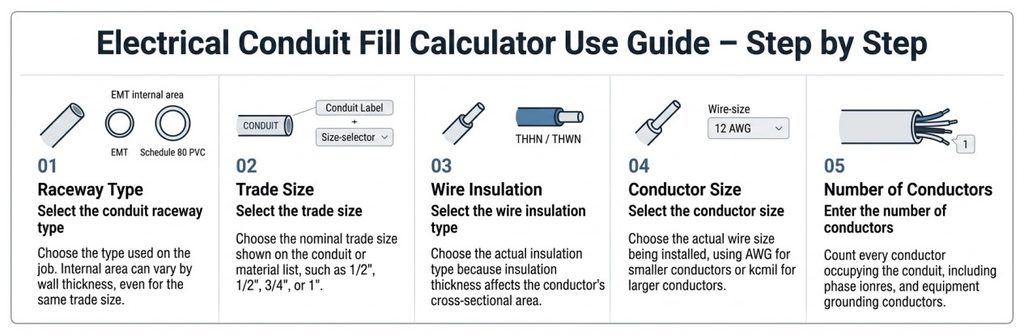
- Select the conduit raceway type. This matters more than people expect. Two conduits with the same trade size can have different internal areas depending on wall thickness. Thin-wall EMT holds more than Schedule 80 PVC of the same trade size. Choose the type that matches what is actually on the job.
- Select the trade size. Trade size is a nominal label (1/2″, 3/4″, 1″, and so on), not a measured diameter. Enter the trade size stamped on the conduit or listed on the material takeoff. Don’t enter an inner-diameter measurement from a tape or caliper.
- Select the wire insulation type. Insulation thickness changes the wire’s cross-sectional area. THHN/THWN wire is thinner than many other insulations, so the same gauge takes up less room. The marking is printed along the jacket. A common mistake is assuming all 12 AWG wire takes up the same space.
- Select the conductor size. Use AWG for smaller sizes or kcmil for large ones. Match the size you’re pulling, not the breaker rating.
- Enter the number of conductors. Count every conductor that will occupy the conduit. That includes neutrals when they’re pulled with the phase conductors, and equipment grounding conductors. Mistakes here are the most common reason a run that looked fine on paper is tight in the field.
Reading the Results
Conduit Total Area is the full internal cross-section of the conduit you selected, in square inches. It comes from the NEC’s published raceway dimensions.
Max Permitted Fill Area is the part of that area the code lets you use. For three or more conductors, the limit is 40% of the total area.
Single Wire Area is the cross-section of one conductor of the size and insulation you chose, including its insulation.
Total Conductor Area is the single-wire area multiplied by the number of conductors.
Conduit Fill Percentage is the total conductor area divided by the conduit total area, expressed as a percentage.
NEC Compliance Check tells you whether that percentage is at or below the applicable limit.
Remaining Usable Capacity is the room left under the permitted area. Divide it by the single-wire area and you have a good idea of how many more conductors of that size could be added later.
The Formula
Fill percentage: Fill % = (N × A_wire) ÷ A_conduit × 100
Permitted area: A_max = A_conduit × Limit
Remaining capacity: A_remaining = A_max − (N × A_wire)
Where:
- N = number of conductors
- A_wire = cross-sectional area of one conductor, including insulation (in²)
- A_conduit = total internal area of the conduit (in²)
- Limit = fill limit from the NEC (0.53 for one conductor, 0.31 for two, 0.40 for three or more)
The limits come from NEC Chapter 9, Table 1. The conduit areas are in Chapter 9, Table 4 and the wire areas are in Table 5. If you mix different wire sizes, add up each conductor’s area separately instead of multiplying one area by N. The formula assumes standard raceway fill rules. It does not cover short nipples, cable trays, wireways, or multiconductor cable, which follow different rules.
Worked Example
Say you need to run six 12 AWG THHN conductors through 3/4″ EMT.
- Single wire area, 12 AWG THHN: 0.0133 in²
- Total conductor area: 6 × 0.0133 = 0.0798 in²
- 3/4″ EMT total area: 0.533 in²
- Max permitted area (40%): 0.533 × 0.40 = 0.2132 in²
- Fill: 0.0798 ÷ 0.533 = 0.1497, or about 15.0%
- Remaining capacity: 0.2132 − 0.0798 = 0.1334 in²
The result is 15% fill against a 40% limit, so the installation passes with room to spare. Dividing 0.1334 by 0.0133 gives about 10, which means roughly ten more 12 AWG THHN conductors could go in, for a total of 16.
Now a failing case. Four 1/0 THHN conductors (0.1855 in² each) come to 0.742 in². In 1-1/4″ EMT (1.496 in² total, 0.598 in² allowed) that is 49.6% fill, so it fails. In 1-1/2″ EMT (2.036 in² total) it is 36.4%, so it passes. This is why the tool works well for choosing conduit size: the answer is the smallest size that passes.
Where the Calculator Helps
- Sizing conduit before you buy. Confirm that a planned run fits before ordering pipe and fittings.
- Adding a circuit to an existing run. Check whether there’s capacity left, or whether a second conduit is needed.
- Comparing raceway types. Test the same conductors in EMT, PVC, and RMC to see how each affects fill.
- Checking a plan before inspection. Catch an overfilled conduit on paper instead of during the pull.
- Bid estimating. Sizing conduit up front avoids surprises in material cost.
Common Mistakes
- Forgetting the ground. Equipment grounding conductors count toward fill. Leaving them out can push a run over the limit.
- Assuming the same gauge means the same area. A 10 AWG wire with thick insulation may take much more space than a 10 AWG THHN. Always match the insulation type.
- Choosing the wrong raceway type. Trade size alone is not enough. Schedule 80 PVC has thicker walls than Schedule 40, so it holds less.
- Reading 40% as a pass mark for the pull. A conduit that technically passes can still be miserable to pull through if the run is long or has many bends. Passing the code and being easy to install are different things.
- Overlooking derating. Fill compliance says nothing about ampacity. More than three current-carrying conductors in one raceway can require adjusted ampacity under the NEC’s derating rules.
Raceway Type Matters
The same trade size does not hold the same amount of wire across raceway types. For 1″ trade size, Chapter 9 Table 4 lists approximately these total internal areas: EMT 0.864 in², RMC 0.887 in², PVC Schedule 40 0.832 in², and PVC Schedule 80 0.688 in². That is a spread of roughly 20% between the largest and smallest. It is the main reason the calculator asks for raceway type before anything else. Confirm against your adopted code edition if the run is close to the limit.
Accuracy, Assumptions, and Limitations
The calculator applies the general fill rules in NEC Chapter 9. It assumes the conductors are all in one raceway, that they are standard round insulated conductors, and that the fill limits for one, two, or more than two conductors apply. It does not include:
- Short nipples. The NEC allows up to 60% fill in nipples not longer than 24 inches between boxes, but the tool applies the standard limits.
- Pulling conditions. Long runs, many bends, and jam ratios all affect how easy the pull is, and the calculator doesn’t model them.
- Ampacity derating. It checks space, not heat.
- Local amendments. Jurisdictions adopt different NEC editions and sometimes add their own rules. Your local authority having jurisdiction has the final say.
- Rounding. Results are calculated from the published table values. Right at the boundary, the NEC’s own Annex C tables can list a count one higher or lower because of rounding, so treat borderline results with caution.
Practical Tips
- Read the insulation marking off the actual wire, not the spec sheet, since substitutions happen.
- Leave headroom on long or bend-heavy runs. If the result is near 40%, consider the next trade size. The extra cost is small compared to a difficult pull.
- Plan for future circuits. The remaining capacity figure tells you whether you can add wires later without replacing the conduit.
- Size neutral and ground into the count first, then test.
Reference Tables
Maximum permitted fill area (40%, three or more conductors) for EMT:
| Trade size | Total area (in²) | 40% area (in²) |
| 1/2″ | 0.304 | 0.122 |
| 3/4″ | 0.533 | 0.213 |
| 1″ | 0.864 | 0.346 |
| 1-1/4″ | 1.496 | 0.598 |
| 1-1/2″ | 2.036 | 0.814 |
| 2″ | 3.356 | 1.342 |
To check a quick count by hand, divide the 40% area by the wire area and round down.
Frequently Asked Questions
What is the NEC conduit fill limit?
40% of the conduit’s internal area for three or more conductors, 31% for two, and 53% for one.
Do ground wires count?
Yes. Equipment grounding conductors occupy space and are included in the count.
Does the calculator work for PVC and RMC as well as EMT?
Yes. Select the raceway type, because internal areas differ between them even at the same trade size.
Why does insulation type change the result?
Each insulation type has a different thickness, so wires of the same gauge take up different amounts of space.
What if my run is under 24 inches?
Short nipples may qualify for a higher fill allowance under the NEC. This calculator uses the standard limits, so check the code directly for that case.
Does passing fill mean my wire size is correct?
No. Fill only checks physical space. Wire size depends on current, distance, and voltage drop.
Related Tools
If you’re not sure what wire gauge to pull in the first place, use the Electrical Wire Gauge Calculator. For long runs where losses matter, check the AC & DC Voltage Drop Calculator before you finalize your conductor size and conduit. Once you know your conductor count and size, come back to the conduit fill calculator to pick the smallest compliant conduit. Check More tools.