
Annual salary Calculator: Hourly to Salary and Salary to Hourly
Our hourly to salary Calculator helps you convert between hourly pay and salary quickly and easily. Use the calculator in either direction: hourly to salary or salary to hourly. Input only annual salary or hourly wage. no need clicks, auto live calculate.
Salary Calculator
Convert an annual salary to an hourly wage, or an hourly wage to an annual salary, and see the gross pay equivalent for every pay period.
Your gross annual pay, before taxes and deductions.
Your gross hourly rate. Decimals are allowed, for example 25.50.
Customize Work Schedule
This adjusts the annual calculation by reducing the number of weeks worked.
Your Salary Breakdown
These are gross pay estimates before taxes and other deductions.
| Pay Period | Pay Periods per Year | Gross Pay |
|---|---|---|
| Annual | 1 | — |
| Monthly | 12 | — |
| Semimonthly | 24 | — |
| Biweekly | 26 | — |
| Weekly | — | |
| Daily | — | |
| Hourly | — |
How We Calculated Your Salary
What This Means
This calculator provides gross pay estimates based on the information you enter. It does not account for taxes, deductions, benefits, or other payroll adjustments. Actual pay may vary.
If you want to estimate your annual salary from an hourly wage, estimate the hourly rate behind an annual salary, or understand your potential take-home pay, this calculator gives you a simple starting point (taxes source: U.S. IRS) The calculator can be useful for comparing job offers, negotiating pay, planning a budget, checking overtime assumptions, and understanding how different pay rates translate into annual earnings.
How to Use the Salary Calculator
Our calculator has two modes:
1. Hourly to Salary – enter your hourly wage to estimate your weekly, monthly, and annual salary.
2. Salary to Hourly – enter your annual salary to estimate the equivalent hourly wage. How to Convert My Salary to an Hourly Wage
Mode 1: Hourly to Salary Calculator
Choose Hourly to Salary, then enter your hourly pay.
For example, if you earn $25 per hour and work 40 hours per week for 52 weeks per year, your estimated gross annual salary is:
$25 × 40 × 52 = $52,000 The calculator can help translate that hourly rate into longer-term salary figures so you can compare different employment offers more easily.
Mode 2: Salary to Hourly Calculator
Choose Salary to Hourly and enter your annual salary.
For example, an annual salary of $62,400 based on a 40-hour workweek and 52 working weeks is equivalent to: $62,400 ÷ 52 ÷ 40 = $30 per hour
This is an estimated hourly equivalent. Your actual hourly rate may differ if your schedule includes unpaid time, overtime, paid leave, or a different number of working hours.
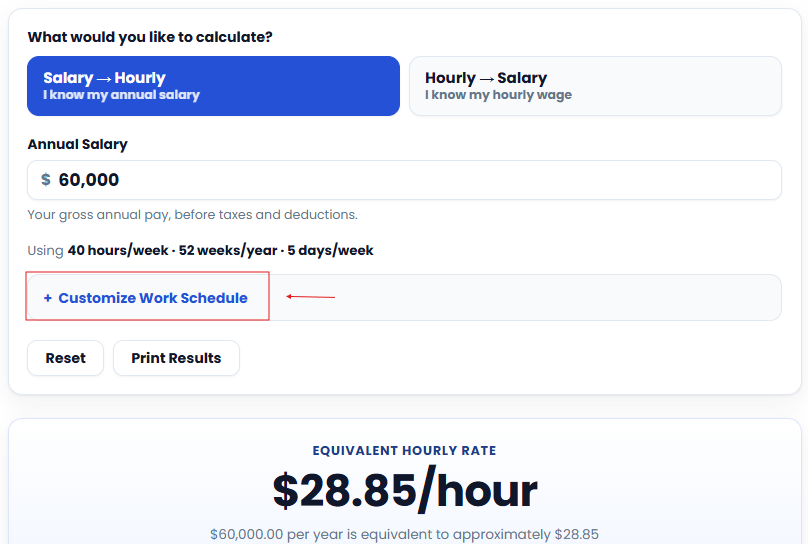
If you want to customize you work schedule you can also do that. As show below:
What Information Should You Enter?
For the most useful estimate, consider your:
- Hourly wage or annual salary
- Hours worked per week
- Number of working weeks per year
- Overtime, if applicable Other regular compensation, if your calculator supports it
The standard calculation often assumes 40 hours per week and 52 weeks per year, but your actual work schedule may be different.
How to Convert Hourly Pay to Annual Salary
The basic hourly wage to annual salary formula is:
Hourly Rate × Hours Per Week × Weeks Per Year = Annual Salary
Using a $20 hourly wage with a 40-hour workweek:
$20 × 40 × 52 = $41,600 So, $20 per hour corresponds to approximately $41,600 in gross annual earnings under those assumptions.
Hourly to Yearly Salary Formula
A common shortcut is: Hourly Rate × 2,080 = Annual Salary. That’s because: 40 hours × 52 weeks = 2,080 hours
For example: Hourly Rate – Estimated Annual Salary
- $15/hour – $31,200
- $20/hour – $41,600
- $25/hour – $52,000
- $30/hour – $62,400
- $35/hour – $72,800
- $40/hour – $83,200
- $50/hour – $104,000
These figures represent gross pay, assuming 40 hours per week and 52 weeks per year.
Why Your Actual Salary Can Be Different
The 2,080-hour assumption doesn’t apply to every worker. Your annual earnings could be different because of:
- Part-time schedules
- Unpaid holidays
- Unpaid vacation
- Variable working hours
- Overtime
- Seasonal employment
- Shift differentials
- Bonuses or commissions Different numbers of working weeks
For example, someone earning $25 per hour who works 40 hours every week for only 50 weeks would earn: $25 × 40 × 50 = $50,000 That’s $2,000 less than the standard 52-week calculation.
Hourly Pay to Annual Salary Examples
Understanding several examples makes it easier to compare hourly compensation with an annual salary.
At 40 hours per week and 52 weeks per year:
- Example 1: $18 per hour, $18 × 40 × 52 = $37,440 – Estimated annual gross salary: $37,440
- Example 2: $25 per hour, $25 × 40 × 52 = $52,000 – Estimated annual gross salary: $52,000
- Example 3: $30 per hour, $30 × 40 × 52 = $62,400 – Estimated annual gross salary: $62,400
- Example 4: $35 per hour, $35 × 40 × 52 = $72,800 – Estimated annual gross salary: $72,800
- Example 5: $50 per hour, $50 × 40 × 52 = $104,000 – Estimated annual gross salary: $104,000
Comparing Two Job Offers
Suppose one employer offers $27 per hour, while another offers an annual salary of $56,000.
Using 2,080 hours per year: $27 × 2,080 = $56,160
The hourly position has an estimated gross annual value of $56,160 under the standard assumption.
However, salary comparisons shouldn’t rely on base pay alone. Consider health insurance, retirement contributions, paid time off, bonuses, overtime eligibility, and other benefits before deciding which offer is better.
Salary After Taxes
Your gross salary amount that not same which reaches your bank account. Gross salary is your earnings before deductions. Net salary, often called take-home pay, is what remains after applicable taxes and other deductions. Our hourly to salary calculator estimate the gross annual, monthly, weekly, biweekly income. Use our independent calculator for Take-home-Pay-calculator you can estimate thru that tool after taxes and other deduction of your net income, but the actual amount depends on your personal circumstances and location.
Common deductions can include:
- Federal income tax
- State income tax
- Social Security tax
- Medicare tax
- Retirement contributions
- Health insurance premiums Other employer or employee deductions
Gross Salary vs Net Salary
Consider an employee with a gross annual salary of $60,000. That does not necessarily mean the employee receives $5,000 in their bank account every month. Taxes and other deductions can reduce the amount actually received. The difference between gross salary and take-home pay is important when creating a household budget or comparing employment offers.
Tax calculations can vary substantially by state and individual circumstances. For example, someone researching a Texas paycheck calculator may have a different result from someone using a California paycheck calculator because state tax rules and individual deductions can differ.
You may also see searches such as paycheck calculator Texas, paycheck calculator California, Illinois paycheck calculator, Florida paycheck calculator, and hourly to salary calculator. These tools focus more specifically on estimating paycheck deductions and net pay.
If you’re comparing your result with an ADP paycheck calculator or another payroll calculator, differences can occur because each calculation may use different assumptions about filing status, benefits, deductions, pay frequency, and tax settings.
Salary to Hourly Pay Conversion
A salary to hourly calculator works in the opposite direction from an hourly wage calculator.
The basic formula is: Annual Salary ÷ Weeks Per Year ÷ Hours Per Week = Hourly Rate
Using a $52,000 annual salary: $52,000 ÷ 52 ÷ 40 = $25 per hour
So, a $52,000 annual salary is equivalent to approximately $25 per hour under a 40-hour, 52-week schedule.
Salary to Hourly Examples
Annual Salary – Approx. Hourly Rate
- $40,000 – $19.23
- $50,000 – $24.04
- $60,000 – $28.85
- $70,000 – $33.65
- $80,000 – $38.46
- $100,000 – $48.08
*Based on 2,080 working hours per year.
Why Salary-to-Hourly Comparisons Matter
An annual salary can sound attractive until you consider the number of hours required to earn it.
For example, a $70,000 salary may equal approximately $33.65 per hour with a standard 40-hour workweek. But if the position regularly requires 50 hours per week, the effective hourly rate based on actual time worked would be lower. That’s why a salary to hourly calculator can be useful when evaluating job offers and workloads.
Salary Calculator vs. Paycheck Calculator
A salary calculator and a paycheck calculator are useful for different purposes.
A salary calculator is mainly used to convert compensation between hourly and annual amounts. For example, you can use it to determine how much an hourly wage could equal over a year or calculate the hourly equivalent of an annual salary.
A paycheck calculator focuses more on individual paychecks and deductions. Depending on the calculator, it may estimate federal taxes, state taxes, Social Security, Medicare, retirement contributions, and other deductions. Use a salary calculator when you want to compare compensation. Use a paycheck calculator when you want to estimate your actual paycheck or take-home pay.
Hourly Pay Calculator for Different Work Schedules
A standard full-time calculation often assumes 40 hours per week and 52 weeks per year. However, not everyone works the same schedule. For example, if you earn $25 per hour:
- 20 hours per week for 52 weeks = $26,000 per year
- 30 hours per week for 52 weeks = $39,000 per year
- 40 hours per week for 52 weeks = $52,000 per year
- 45 hours per week for 52 weeks = $58,500 per year before considering overtime rules
This is why entering your actual work schedule into an hourly pay calculator can provide a more useful estimate than relying on a simple hourly-rate shortcut.
Salary Calculator for Job Offer Comparisons
A salary number doesn’t always tell the complete story when comparing two jobs.
Suppose one employer offers: $30 per hour
and another offers: $65,000 per year
At 40 hours per week and 52 weeks per year, $30 per hour equals: $30 × 2,080 = $62,400
The annual salary offer is therefore approximately $2,600 higher in gross base pay under the standard assumptions. But, the second job isn’t automatically better.
You should also compare:
- Paid vacation
- Health insurance
- Retirement contributions
- Bonuses
- Commissions
- Overtime eligibility
- Expected weekly hours
- Remote-work benefits
- Commuting costs Unpaid time off
A hourly to salary calculator gives you a useful numerical starting point, but the total compensation package matters when making a job decision.
Why Hourly and Salary Pay Are Not Always Directly Comparable
Converting hourly pay to salary is mathematically straightforward, but employment compensation can be more complicated. An hourly employee may receive overtime pay for eligible hours beyond their normal schedule. A salaried employee may have a fixed annual salary but work different numbers of hours each week.
For example, two employees could both have compensation equivalent to $70,000 per year, but one might work 40 hours per week while another regularly works 50 hours.
Their effective earnings per hour would be different. This is why using hourly to salary calculator for both salary to hourly and hourly to salary calculations can provide a clearer picture of compensation.
How Many Hours Are in a Full-Time Work Year?
A commonly used full-time work-year assumption is 2,080 hours. The calculation is: 40 hours × 52 weeks = 2,080 hours This figure is useful for salary comparisons, but it doesn’t mean every employee actually works 2,080 paid hours. Vacation, holidays, sick days, unpaid leave, overtime, and different work schedules can change the actual number of hours worked.
For that reason, treat the 2,080-hour figure as a standard calculation assumption rather than a universal rule.
How to Estimate Your Paycheck From an Annual Salary
Once you know your annual salary, you can estimate gross pay per paycheck by dividing your salary by the number of pay periods.
For example, with a $60,000 annual salary:
- Weekly: approximately $1,153.85
- Biweekly: approximately $2,307.69
- Semimonthly: $2,500
- Monthly: $5,000
These are gross amounts before taxes and deductions. Your actual take-home paycheck will depend on your tax withholding, benefits, retirement contributions, and other deductions.
Salary Calculator and Take-Home Pay
When people search for a salary calculator after taxes, they are usually looking for an estimate of how much money they will actually receive. The calculation is more complicated than simply subtracting one percentage from your salary. Your take-home pay can depend on factors such as:
- Filing status
- Taxable income
- Federal withholding
- State taxes
- Social Security
- Medicare
- Retirement contributions
- Health insurance Other payroll deductions
For that reason, an hourly to salary calculator should generally be treated as a gross-pay estimate, while a paycheck calculator is better suited to estimating net pay.
Frequently Asked Questions
1. What is an hourly to salary calculator?
Answer: An hourly to salary calculator converts an hourly wage into estimated weekly, monthly, or annual gross earnings. It normally uses your hourly rate, hours worked per week, and working weeks per year.
2. How do I calculate my annual salary from an hourly wage?
Answer: Multiply your hourly wage by the number of hours you work each week and then multiply that result by the number of weeks you work each year. For a standard full-time schedule: Hourly wage × 40 × 52 = annual salary
3. How much is $20 an hour per year?
At 40 hours per week and 52 weeks per year, $20 per hour equals approximately $41,600 per year before taxes and other deductions.
4. How much is $25 an hour per year?
At 40 hours per week and 52 weeks per year, $25 per hour equals approximately $52,000 per year in gross pay.
5. How much is $30 an hour per year?
At a standard 40-hour workweek for 52 weeks, $30 per hour equals approximately $62,400 per year before taxes.
6. What is a $60,000 salary per hour?
Assuming 40 hours per week and 52 weeks per year, a $60,000 annual salary equals approximately $28.85 per hour.
7. What is the difference between gross salary and take-home pay?
Gross salary is your earnings before taxes and deductions. Take-home pay, or net pay, is the amount remaining after applicable taxes and other deductions.
8. Does an annual salary calculator include taxes?
An annual salary calculator generally calculates gross earnings unless it specifically includes tax calculations. A salary calculator after taxes uses additional information to estimate net or take-home pay.
Is an hourly to salary calculator the same as a paycheck calculator?
Not necessarily. An hourly pay calculator typically converts an hourly wage into salary or earnings. A paycheck calculator generally focuses on estimating the amount of an individual paycheck after taxes and deductions.
10. Why is my calculator result different from a paycheck calculator?
Different calculators can use different assumptions for tax filing status, pay frequency, benefits, retirement contributions, overtime, state taxes, and other deductions. Always check the assumptions used by each calculator.
11. Can I use a salary to hourly calculator to compare job offers?
Yes. Converting an annual salary into an estimated hourly rate can make different compensation packages easier to compare. However, also consider benefits, paid time off, bonuses, overtime, retirement contributions, and the actual number of hours you’ll work.
Final Thoughts
Whether you’re starting a new job, negotiating compensation, planning your budget, or comparing an hourly position with a salaried role, converting between hourly pay and annual salary can make the numbers much easier to understand.
Use our hourly to salary calculator to switch between Hourly to Salary and Salary to Hourly modes and get an estimate based on your working schedule. Remember that salary calculations are estimates. Your actual earnings and take-home pay can change because of taxes, deductions, overtime, unpaid time off, benefits, and other factors. And if you want to try our other calculator for financial knowledge.