
If you know your annual salary but want to understand how much you actually earn per hour, a Salary to Hourly Calculator can give you a quick answer. Converting an annual salary into an hourly wage is useful when comparing job offers, planning a budget, checking overtime pay, or deciding whether a new position is financially worthwhile.
The basic calculation is simple: divide your annual salary by the number of hours you work in a year. For a typical full-time U.S. employee who works 40 hours per week for 52 weeks, that equals 2,080 working hours per year. Hourly wage = Annual salary ÷ 2,080
For example, a $60,000 annual salary works out to about $28.85 per hour before taxes and other deductions. This guide explains how to calculate your hourly wage from your salary and answers common questions such as “What is a $40,000 salary hourly?”, “How much an hour if I make $60,000 a year?”, and “What is $70,000 a year hourly?”
How Do I Calculate My Annual Salary Into Hourly Wage?
To calculate your hourly wage from an annual salary, you need two numbers:
- Your annual gross salary.
- The number of hours you work each year.
For a standard full-time schedule, the calculation is: 40 hours × 52 weeks = 2,080 hours. Then divide your salary by 2,080.
Example: Suppose your annual salary is $50,000. $50,000 ÷ 2,080 = $24.04 per hour
So, someone earning $50,000 per year and working 40 hours every week earns approximately $24.04 per hour before taxes. This is an estimate based on a standard work schedule. Your actual hourly equivalent can be different if you work fewer hours, take unpaid time off, work overtime, or have a different number of working weeks during the year.
For example:
- $40,000 ÷ 2,080 = $19.23/hour
- $50,000 ÷ 2,080 = $24.04/hour
- $60,000 ÷ 2,080 = $28.85/hour
- $70,000 ÷ 2,080 = $33.65/hour
- $80,000 ÷ 2,080 = $38.46/hour
- $100,000 ÷ 2,080 = $48.08/hour
Table of Contents
How Do I Calculate My Salary into Hourly If I Don’t Work 40 Hours?
The standard 2,080-hour calculation works well for a typical 40-hour workweek, but not everyone has the same schedule. If you work 35 hours per week, for example, you will calculate your annual working hours like this: 35 × 52 = 1,820 hours
If your annual salary is $60,000: $60,000 ÷ 1,820 = $32.97 per hour
The same salary can therefore have a different hourly equivalent depending on how many hours you work. This is especially important when comparing a salaried position with an hourly job. A $60,000 salary may look attractive, but if one position regularly requires 50 hours per week and another requires 40, the effective hourly earnings are very different.
What Is a $40,000 Salary Hourly?
If you earn $40,000 per year and work 40 hours per week for 52 weeks, your approximate hourly wage is: $40,000 ÷ 2,080 = $19.23 per hour
So, a $40,000 salary is about $19.23 an hour before taxes and deductions. Here is a simple breakdown:
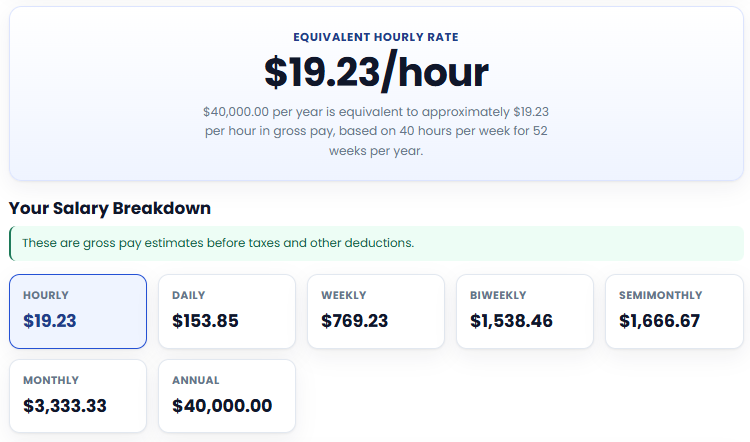
Your actual paycheck may be lower because employers generally withhold applicable taxes and other deductions from your gross pay.
How Much an Hour If I Make $60,000 a Year?
If you make $60,000 a year, work 40 hours each week, and work 52 weeks per year, your hourly equivalent is: $60,000 ÷ 2,080 = $28.85 per hour
Therefore, a $60,000 salary is approximately $28.85 an hour. Estimated gross pay would be:
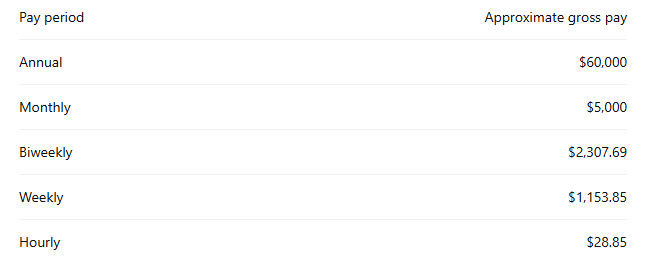
These numbers are gross estimates and do not represent take-home pay.
What Is $70,000 a Year Hourly?
A $70,000 annual salary is approximately $33.65 per hour when based on a 40-hour workweek and 52 working weeks. The calculation is: $70,000 ÷ 2,080 = $33.65 per hour Here is the estimated gross pay breakdown:
- Annual = $70,000
- Monthly = $5,833.33
- Biweekly = $2,692.31
- Weekly = $1,346.15
- Hourly = $33.65
Again, your take-home income will depend on taxes, benefits, retirement contributions, and other deductions. Or you can use our Take home pay calculator instant.
Salary to Hourly Conversion Chart
If you want a quick reference, this salary-to-hourly chart shows common annual salaries using the standard 2,080-hour work year.
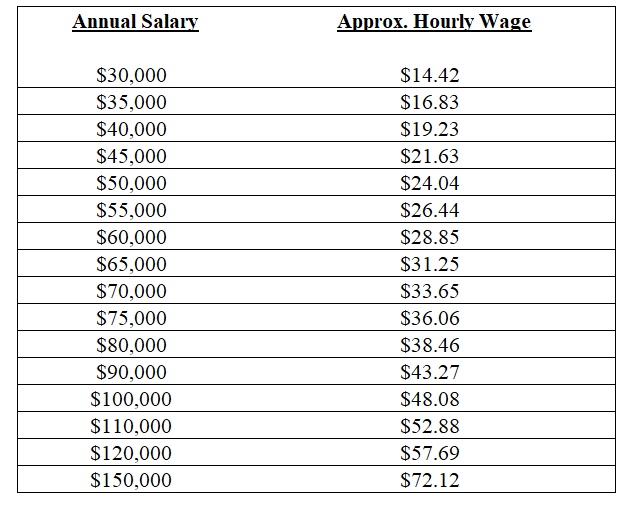
The figures are rounded to the nearest cent.
Why Convert Annual Salary to Hourly Pay?
Knowing your hourly equivalent can make salary comparisons much easier.
Compare job offers
A company may offer a higher annual salary, but the position could require significantly more working hours. Converting both offers to an hourly figure can give you a clearer comparison.
Understand your earning power
An annual salary tells you your yearly income, while an hourly rate shows what your time is worth based on your work schedule.
Calculate overtime
For eligible hourly workers, an hourly rate can also help with overtime calculations. However, overtime rules depend on federal and state laws and whether a worker is legally classified as exempt or nonexempt, so an annual-salary conversion should not automatically be treated as the worker’s legally required overtime rate.
Build a personal budget
Converting salary into weekly or monthly income can make it easier to estimate how much money is available for rent, food, transportation, savings, debt payments, and other expenses.
Salary vs. Hourly Pay: What’s the Difference?
A salaried employee generally receives a set amount of compensation over a pay period, regardless of the exact number of hours worked, subject to the terms of employment and applicable wage laws. An hourly employee is generally paid based on the number of hours worked. Neither method is automatically better. The right choice depends on the job, benefits, schedule, overtime eligibility, job security, and total compensation package. But overtime rules depend on Federal and State laws and whether a worker is legally classified as exempt or nonexempt.
For example, imagine two jobs:
- Job A: $60,000 salary with a 40-hour workweek
- Job B: $55,000 salary equivalent with a 35-hour workweek
Job A pays more annually, but Job B could provide a higher effective hourly value because you spend fewer hours working.
That is why salary-to-hourly conversion is useful when evaluating the full value of a job.
Does Paid Time Off Change the Hourly Calculation?
It can, depending on what you are trying to measure. The standard calculation assumes 40 hours × 52 weeks = 2,080 hours. This is a convenient way to calculate the hourly equivalent of a salary.
But if you want to determine the effective value of each hour actually worked, you may want to account for unpaid leave, paid vacation, holidays, or other time away from work.
For example, if someone receives a $60,000 salary but actually works fewer hours because of paid vacation and holidays, the effective compensation per hour actually worked can be higher than $28.85. For consistent salary comparisons, however, the 2,080-hour method is commonly used as a simple benchmark.
Is My Hourly Wage the Same as My Take-Home Pay?
No. Your hourly wage based on salary is a gross-pay calculation. It does not tell you how much money you will receive in your bank account. Your paycheck can be reduced by items such as:
- Federal income tax
- State and local taxes, where applicable
- Social Security tax
- Medicare tax
- Health insurance premiums
- Retirement contributions
- Other payroll deductions
Your actual take-home pay depends on your individual circumstances. If you want to estimate your net hourly income, you would first need to determine your expected annual take-home pay and then divide that amount by the number of hours worked.
Quick Salary to Hourly Formula
For a typical full-time U.S. schedule, remember this simple formula: Annual salary ÷ 2,080 = hourly wage
For example: $70,000 ÷ 2,080 = $33.65/hour
If your schedule is different, use: Annual salary ÷ (hours per week × weeks worked per year) = hourly wage
This second formula is more flexible because it lets you account for your actual schedule.
Frequently Asked Questions & Short Answer
How do I calculate my annual salary into hourly wage?
Answer: Annual salary ÷ the number of hours you work in a year. For a standard 40-hour workweek over 52 weeks, divide your salary by 2,080.
How do you calculate your hourly from salary?
Answer: Use this formula: annual salary ÷ (hours worked per week × weeks worked per year). For a typical full-time schedule, this becomes annual salary ÷ 2,080.
How do I calculate my salary into hourly?
Answer: If you work 40 hours per week, multiply 40 by 52 to get 2,080 annual hours. Then divide your annual salary by 2,080.
What is a $40,000 salary hourly?
Answer: A $40,000 annual salary is approximately $19.23 per hour when based on 40 hours per week and 52 weeks per year.
How much an hour if I make $60,000 a year?
Answer: A $60,000 annual salary equals approximately $28.85 per hour based on a 40-hour workweek and 52 weeks per year.
What is $70,000 a year hourly?
Answer: A $70,000 salary equals approximately $33.65 per hour using the standard 2,080-hour work year.
How many hours I worked in year if I work full-time?
Answer: Using the common U.S. assumption of 40 hours per week and 52 weeks per year, there are 2,080 work hours in a year.
Can I calculate an hourly wage from any annual salary?
Answer: Yes. Divide the annual salary by your estimated annual working hours. If you work a different schedule from 40 hours per week, use your actual weekly hours and working weeks.
Conclusion
A Salary to Hourly Calculator is a simple way to understand what an annual salary means in terms of your time. The standard calculation uses 2,080 working hours per year, but your personal hourly equivalent can change depending on your schedule.
As a quick reference, $40,000 is about $19.23 an hour, $60,000 is about $28.85 an hour, and $70,000 is about $33.65 an hour when based on a 40-hour workweek.
Tips: When comparing jobs, don’t look at salary alone. Consider working hours, overtime eligibility, paid time off, health benefits, retirement contributions, bonuses, commuting costs, and other parts of the compensation package. Looking at the complete picture can help you understand the real value of an employment offer.
If you want to try our other free Calculator, Explore all Calculator.