
Before buying a home, one of the most useful numbers to know is the amount you may need to pay each month. So, learn how to calculate a monthly mortgage payment using the mortgage payment formula.
But there is a catch: the number shown in a mortgage calculator is not always the same as the amount that leaves your bank account each month. A mortgage payment can involve the loan itself, interest, property taxes, homeowner’s insurance, and sometimes mortgage insurance.
If you understand how each part is calculated, it becomes much easier to compare homes, loan terms, and interest rates. This guide explains how to calculate monthly mortgage payment from the ground up, including the formula, a worked example, taxes and insurance, and ways to estimate your real monthly housing cost.
Table of Contents
How do you calculate a monthly mortgage payment?
For a standard fixed-rate mortgage, the principal-and-interest portion is calculated from three numbers:
- The amount borrowed
- The interest rate
- The repayment period
The mathematical formula is: M = P × [r(1+r)^n] / [(1+r)^n − 1]
Here:
- M represents the monthly principal-and-interest payment.
- P is the original loan balance.
- r is the monthly interest rate.
- n is the total number of monthly payments.
For example, a 30-year mortgage has: 30 × 12 = 360 monthly payments If the interest rate is 6%, the monthly rate used in the formula is: 0.06 ÷ 12 = 0.005
This calculation gives you the mortgage’s principal-and-interest payment. It does not automatically tell you the complete amount you may pay for housing each month. That distinction is important because taxes, homeowners insurance, and mortgage insurance may be added to the payment. The CFPB explains that the principal-and-interest calculation is based on the loan amount, interest rate, and loan term, while the total payment can include additional property-related costs.
The five numbers you need before calculating
You don’t need complicated financial software to make a basic estimate. Start by collecting these figures.
1. Purchase price
This is the agreed price of the property. For example: Home price = $350,000
2. Down payment
Your down payment is the amount you pay toward the home upfront rather than borrowing. Suppose you put down 15%: $350,000 × 0.15 = $52,500
3. Mortgage amount
Subtract the down payment from the purchase price: $350,000 − $52,500 = $297,500. So, the estimated starting loan balance is $297,500.
4. Interest rate
Next, you need the annual mortgage interest rate. Suppose the rate is: 6.25%. For the monthly mortgage formula, convert it to a decimal and divide by 12: 0.0625 ÷ 12 = 0.0052083
5. Loan term
Finally, determine how long the mortgage will be repaid. For a 30-year mortgage: 30 × 12 = 360 payments. Once you have these figures, you can calculate the principal-and-interest portion of the payment.
Mortgage payment formula, explained simply
The mortgage payment formula looks complicated because it accounts for interest accumulating on a balance that gradually decreases.
The formula is: M = P × [r(1+r)^n] / [(1+r)^n − 1] You can think of it this way:
- P tells the formula how much you borrowed.
- r tells it how expensive the borrowing is each month.
- n tells it how many payments you will make.
- M is the resulting monthly principal-and-interest payment.
The formula is designed for an amortizing fixed-rate loan, where scheduled payments gradually reduce the balance until the loan is paid off at the end of the agreed term. You don’t have to calculate this by hand every time. A calculator or spreadsheet can perform the same mathematics much faster.
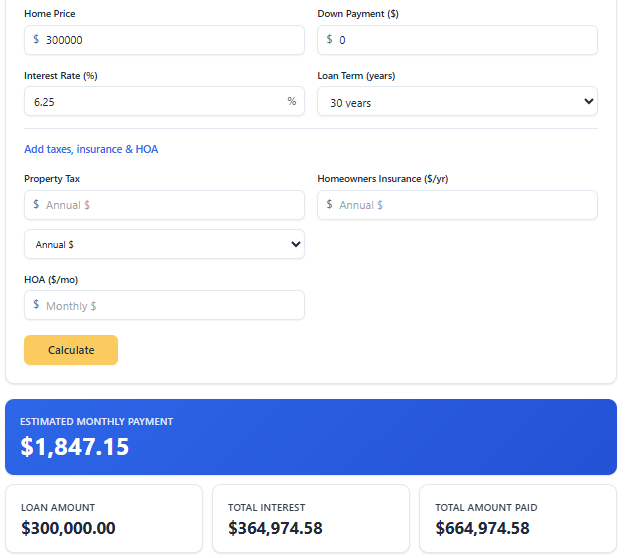
Example: Calculate a $300,000 mortgage payment
Let’s use a simple example. Assume you borrow:
- Loan amount: $300,000
- Interest rate: 6.25%
- Term: 30 years
- Down payment: $0
Step 1: Convert the interest rate
Annual rate: 6.25%. Decimal: 0.0625. Monthly rate: 0.0625 ÷ 12 = 0.0052083
Step 2: Find the number of payments
A 30-year mortgage has: 30 × 12 = 360 payments
Step 3: Apply the formula
Put the numbers into: M = P × [r(1+r)^n] / [(1+r)^n − 1]
Using:
- P = $300,000
- r = 0.0052083
- n = 360
The estimated principal-and-interest payment is approximately: $1,847 per month. That number is useful, but it should not automatically be treated as your complete mortgage bill. Your actual payment could be higher after adding property taxes, homeowners insurance, and mortgage insurance where applicable.
Why your actual mortgage payment may be higher?
This is one of the most important things to understand when using a monthly mortgage calculator. A calculator may show you a principal-and-interest figure, while your lender’s projected total payment can contain additional charges.
A simplified version is: Principal + Interest + Taxes + Insurance + Mortgage Insurance = Total Monthly Payment
Not every homeowner has every item, and some expenses may be paid separately. The CFPB identifies principal, interest, taxes, and insurance as the four basic components commonly referred to as PITI. Mortgage insurance may also be part of the payment when applicable.
How to estimate taxes and insurance
Suppose your annual property tax is: $4,800. A simple monthly estimate is: $4,800 ÷ 12 = $400. Now suppose your annual homeowners insurance premium is: $1,560
Monthly estimate: $1,560 ÷ 12 = $130. If your principal-and-interest payment is $1,847, the rough monthly total becomes: $1,847 + $400 + $130 = $2,377
So, you might budget around: $2,377 per month. before adding any applicable mortgage insurance or other costs. This is an estimate, not a lender quote. Property taxes and insurance vary by property and location.
How mortgage insurance can change the payment
Mortgage insurance is another cost some borrowers need to consider. For example, conventional borrowers with a smaller down payment may be required to pay private mortgage insurance (PMI), depending on the loan.
If PMI applies, it can increase the monthly amount you need to budget.
The CFPB notes that mortgage insurance is commonly associated with loans where the borrower makes a down payment below 20%, although the exact requirements depend on the loan. This is one reason you shouldn’t compare mortgages using the principal-and-interest number alone.
How your down payment affects the payment
The down payment has a direct effect on how much you need to borrow. Consider a $400,000 home.
With 10% down
Down payment: $400,000 × 10% = $40,000. Loan: $400,000 − $40,000 = $360,000.
With 20% down
Down payment: $400,000 × 20% = $80,000. Loan: $400,000 − $80,000 = $320,000
The second example requires $40,000 less borrowing.
A smaller loan generally means a smaller principal-and-interest payment. Depending on the mortgage program, the down payment can also affect whether mortgage insurance is required. However, using more of your cash for a down payment isn’t automatically better. A buyer also needs to consider closing costs, reserves, repairs, moving expenses, and other financial needs.
How the interest rate changes your payment
Two buyers can purchase homes at the same price and still have different monthly payments.
Why?
Their financing could be different. How much you pay for home money it’s will affects on interest rate. A higher rate generally produces a higher required payment when the loan amount and term stay the same.
For example, imagine two borrowers each take a $300,000 30-year fixed mortgage. One receives a rate of 5.75%. The other receives 6.75%.
Their purchase price and loan amount are identical, but their monthly principal-and-interest payments will not be. This is why the interest rate should be considered alongside the purchase price when estimating affordability.
How to use a mortgage calculator correctly
A monthly mortgage calculator is most useful when you use realistic inputs. Instead of entering only the home price, gather:
- Expected purchase price
- Down payment
- Estimated interest rate
- Mortgage term
- Property tax estimate
- Homeowners insurance estimate
- PMI estimate, if applicable
Then test different scenarios. For example:
- What happens if I increase the down payment?
- What happens if the interest rate rises by 0.5%?
- How different is a 15-year payment from a 30-year payment?
- What happens if I look at a $350,000 home instead of $400,000?
These comparisons can be more useful than calculating one payment and stopping there.
How to estimate mortgage payment before buying a home
You don’t need to wait until you’ve found your dream house to start estimating. A practical approach is:
- Start with a realistic home price (Don’t choose a price simply because a lender says you qualify for it.)
- Estimate your down payment (Know how much cash you expect to put into the purchase.)
- Research current loan options (Interest rates and loan terms can vary.)
- Estimate property taxes (Your county or local taxing authority can provide useful information about property taxes for a particular property.)
- Get an insurance estimate (Insurance costs can vary significantly depending on the home and location.)
- Include mortgage insurance if necessary (Don’t assume a smaller down payment will have no additional monthly cost.)
- Calculate the total (Then compare the resulting payment with your household budget.)
The CFPB makes an important distinction between what you qualify to borrow and what you can comfortably afford.
Mortgage payment vs. total cost of owning a home
Your mortgage payment is only one piece of the homeownership budget. You may also have:
- HOA dues
- Utilities
- Routine maintenance
- Major repairs
- Home improvements
- Insurance not included in escrow
- Property-related assessments
For example, replacing a roof doesn’t normally appear in a mortgage calculator. But it is still a real cost of owning a house. That’s why a sensible home-buying budget should leave room for expenses beyond the mortgage payment.
Frequently asked questions
What is the easiest way to calculate a mortgage payment?
The easiest method is to use a mortgage calculator. Enter the loan amount, interest rate, and loan term to estimate principal and interest. Then add estimated taxes, insurance, and mortgage insurance when applicable.
What is the mortgage payment formula?
For a standard fixed-rate amortizing mortgage, the formula is:
M = P × [r(1+r)^n] / [(1+r)^n − 1] The variables represent the loan amount, monthly interest rate, number of payments, and resulting monthly principal-and-interest payment.
Does the mortgage payment include property taxes?
It may. If taxes are collected through escrow, they can be included in the amount you pay to your mortgage servicer each month. Otherwise, you may pay the tax bill separately.
Does a mortgage payment include homeowners’ insurance?
It can. Many mortgages use escrow to collect homeowners insurance payments, but arrangements vary by loan.
What does PITI mean?
PITI means principal, interest, taxes, and insurance. It is a common way of describing the major components of a mortgage payment.
Does a bigger down payment lower the monthly payment?
Usually, yes. A larger down payment reduces the amount you need to borrow. It can also affect mortgage insurance requirements depending on the loan.
Is a 30-year mortgage cheaper than a 15-year mortgage?
Usually not when comparing total scheduled interest over the full loan term. A 30-year mortgage generally has a lower required monthly payment, while a 15-year mortgage generally requires higher monthly payments but can reduce total interest.
Why is my total payment higher than the mortgage calculator result?
A calculator may initially show only principal and interest. Your actual payment may also include property taxes, homeowners insurance, mortgage insurance, or other applicable charges.
Can my mortgage payment increase even with a fixed-rate mortgage?
The principal-and-interest portion of a typical fixed-rate mortgage generally stays the same. However, your total payment can change if escrowed taxes or insurance costs change.
How do I know what I can afford for monthly mortgage payment?
Start with your complete household budget rather than the maximum amount a lender is willing to approve. Include debts, insurance, taxes, savings, maintenance, and other recurring expenses.
Conclusion
To calculate monthly mortgage payment, start with the amount you plan to borrow, your interest rate, and the length of the loan.
That gives you the principal-and-interest portion. But if you’re trying to figure out what homeownership will actually cost each month, go one step further. Add the property taxes, homeowners insurance, mortgage insurance, and other applicable expenses.
A useful estimate therefore has two layers: Mortgage payment = principal + interest and Estimated housing payment = principal + interest + applicable taxes + insurance + mortgage insurance + other applicable costs
Using both numbers gives you a much clearer picture of the home you can realistically afford. Before committing to a mortgage, compare your estimate with the lender’s Loan Estimate and review the projected total monthly payment and other loan costs. The CFPB provides a detailed guide for reading the Loan Estimate. This calculation was according to Net pay salary. if you don’t know your Net pay/salry after tax. Try our Take home pay Calculator for free.
Official sources
- Consumer Financial Protection Bureau – Mortgage payment calculation
- Consumer Financial Protection Bureau – Principal, interest, and total payment