
Percentages show up everywhere restaurant tips, sale prices, test scores, interest rates yet the moment a percentage question doesn’t match the “obvious” example we memorized in school, it’s easy to freeze. The good news is that almost every percentage problem you’ll ever run into boils down to one of three questions, and each one has a simple, repeatable formula behind it.
This guide walks through the core formula, shows it in action with real numbers, gives you mental-math shortcuts for the percentages you see most often. You can use our Percentage Calculator for quick answers; however, knowing the method makes it much easier to verify results and solve common percentage-related problems on your own.
The Core Formula
To find a percentage of a number, use:
Value = (Percentage ÷ 100) × Number
So, if you wanted 30% of 90, you’d calculate:
(30 ÷ 100) × 90 = 27 – 30% of 90 is 27.
That’s genuinely the whole trick. Everything else in this article is just this formula applied to different situations or a faster way to get there without picking up a calculator.
If you’d rather skip the arithmetic entirely, our Percentage Calculator will give you the answer instantly. But it’s still worth understanding the method, since it lets your sanity-check results, work through problems on paper, and recognize which formula a question is actually asking for which, as you’ll see below, isn’t always obvious.
Table of Contents
What “Percent” Actually Means
“Percent” comes from the Latin per centum “per hundred.” A percentage is just a way of describing a portion out of 100, which makes it easy to compare quantities regardless of their original size. A few reference points:
- 10% means 10 out of 100.
- 25% means 25 out of 100.
- 50% means half.
- 75% means three-quarters.
- 100% means the entire amount.
Because a percentage is really just a fraction of 100, it converts cleanly to a decimal: 25% is 0.25, 50% is 0.50, and so on. That conversion is the step most people skip in their heads without realizing it and it’s the key to the formula above.
Finding a Percentage of a Number, Step by Step
Let’s find 35% of 220.
- Step 1. Identify the percentage. Here it’s 35.
- Step 2. Turn it into a decimal. 35 ÷ 100 = 0.35
- Step 3. Multiply by the number. 0.35 × 220 = 77
So 35% of 220 is 77.
This same three-step process holds up no matter how odd the numbers look whole numbers, decimals, fractions, even very large totals.
More Worked Examples
- What is 18% of 150? 18 ÷ 100 = 0.18 0.18 × 150 = 27 Answer: 27
- What is 40% of 65? 40 ÷ 100 = 0.40 0.40 × 65 = 26 Answer: 26
- What is 6.5% of 300? 6.5 ÷ 100 = 0.065 0.065 × 300 = 19.5 Answer: 19.5
- What is 37.5% of 96? 37.5% converts to 0.375 0.375 × 96 = 36 Answer: 36
want more real example or, want to get what you need then below the road map how to use our Percentage Calculator.
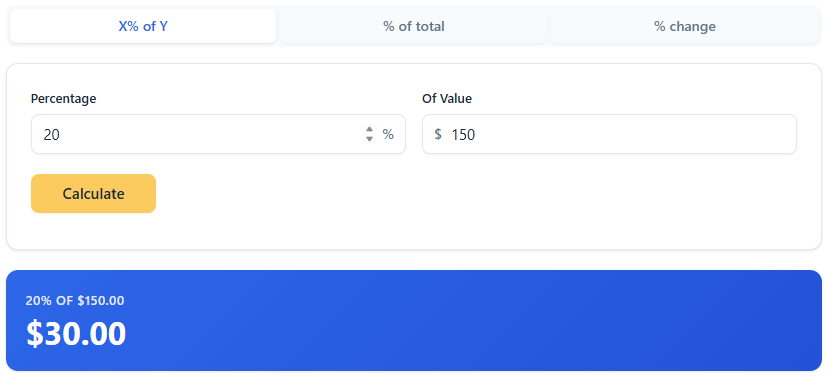
First, convert 20% to a decimal: 20 ÷ 100 = 0.20. Then multiply: 0.20 × 150 = 30. So, 20% of 150 is 30.
Mental-Math Shortcuts (No Calculator Needed)
Certain percentages map onto simple fractions, which means you can often solve them faster in your head than by typing into a calculator.
- 10% divide by 10 10% of 480 = 48
- 1% divide by 100 1% of 480 = 4.8
- 50% cut in half 50% of 360 = 180
- 25% divide by 4 25% of 360 = 90
- 5% find 10%, then halve it 10% of 140 = 14, so 5% of 140 = 7
- 75% add 50% and 25% together For 160: 50% = 80, 25% = 40, so 75% = 120
These shortcuts come in handy for everyday situations splitting a bill, eyeballing a discount at checkout, or estimating a tip before the receipt even prints.
Three Percentage Questions That Get Mixed Up
Not every percentage problem is asking for the same thing, and using the wrong formula is one of the most common reasons people get stuck. Take the numbers 45, 180, and 25% they can be arranged into three completely different questions.
- What is 25% of 180? You know the rate and the whole amount. 25% × 180 = 45 Answer: 45
- 45 is what percent of 180? You know a part and the total, and you’re solving for the rate. (45 ÷ 180) × 100 = 25% Answer: 25%
- 45 is 25% of what number? You know the rate and the part, but not the total. 0.25 × Number = 45 Number = 45 ÷ 0.25 = 180 Answer: 180
Same three numbers, three different unknowns. The trick isn’t memorizing more formulas it’s pausing for a second to identify what’s missing before you start calculating.
Finding What Percentage One Number Is of Another
When you know a part and a total and want the rate, use: Percentage = (Part ÷ Total) × 100
Say you got 34 out of 40 on a quiz.
(34 ÷ 40) × 100 = 85% – You scored 85%.
This version of the formula is the one behind grading, survey results, conversion rates, attendance figures, and pretty much any “how much of the whole does this represent” question.
Finding the Original Number
Sometimes you’re told what a percentage equals, and you need to work backward to the full amount.
20% of a number is 36. What’s the number?
Convert the percentage: 20 ÷ 100 = 0.20. Divide the known value by that decimal: 36 ÷ 0.20 = 180
So 36 is 20% of 180.
A quick way to sanity-check this: since 20% is one-fifth, 36 representing one-fifth of the total means the whole should be five times as large 36 × 5 = 180. Same answer, different route.
How to Calculate a Percentage Increase
Percentage increase tells you how much something has grown relative to where it started.
Percentage Increase = ((New Value − Original Value) ÷ Original Value) × 100. Say a streaming plan goes from $12 to $15.
Difference: $15 − $12 = $3 Relative to the original: $3 ÷ $12 = 0.25 As a percentage: 0.25 × 100 = 25%. The price went up 25%.
The important detail here is the denominator: you’re always comparing the change to the original value, not the new one.
Percentage Decrease
The formula flips slightly for a decrease: Percentage Decrease = ((Original Value − New Value) ÷ Original Value) × 100
Say a pair of shoes drops from $85 to $68.
Decrease: $85 − $68 = $17 Relative to the original: $17 ÷ $85 = 0.20 As a percentage: 20%. The price fell by 20%.
Calculating a Discount
A discount is just a percentage taken off the original price. Say a $150 jacket is 40% off.
Discount amount: 40% of $150 = $60 Final price: $150 − $60 = $90
So the original price is $150, the discount is $60, and the price you actually pay is $90. It’s worth keeping those three numbers separate in your head, since “the discount” and “the final price” are two different figures people sometimes confuse.
Calculating a Tips
The same formula covers tipping. Say your check comes to $54, and you want to leave 18%.
18% of $54 = $9.72
Round that however feels natural, and add it to your bill: $54 + $9.72 = $63.72
Common Percentage Mistakes
Skipping the “divide by 100” step. 20% of 150 is not 20 × 150. You need 20 ÷ 100 × 150 = 30. Forgetting to convert the percentage into a decimal or fraction first is the single most common slip-up.
Using the wrong base number. For increase and decrease problems, the original value is almost always the denominator. If a price moves from $40 to $52, the increase is $12 ÷ $40 = 30% not $12 ÷ $52.
Mixing up percentages with percentage points. If a tax rate moves from 15% to 18%, that’s a 3-percentage-point jump. But relative to the starting rate, it’s actually a ((18 − 15) ÷ 15) × 100 = 20% increase. Both statements are true they’re just answering different questions, so it matters which one you’re using.
Rounding too soon. If you’re working through several decimal steps, hold onto the extra digits until the very last calculation. Rounding in the middle of a multi-step problem can nudge your final answer off by more than you’d expect.
When It’s Worth Reaching for a Calculator
Mental math is usually fast enough for round numbers like 10%, 25%, or 50%. A calculator earns its keep when:
- The percentage involves decimals (like 8.25%)
- You’re working with large or awkward numbers
- You need to run several calculations in a row
- You’re dealing with financial figures where precision matters
- You just want to double-check a manual answer
For something like 22.5% of 847.60, a calculator gets you a precise answer instantly, without the risk of a small arithmetic slip. If you’d rather not run the numbers by hand, our Percentage Calculator handles it in one step.
Quick Reference
“What is X% of Y?” X% of Y = (X ÷ 100) × Y
“X is what percent of Y?” (X ÷ Y) × 100 – How to Calculate Percentage Difference (Full guide)
The real skill isn’t memorizing either formula it’s pausing to figure out which piece of information is missing before you pick one.
Frequently Asked Questions
What’s the easiest way to find a percentage of a number?
Convert the percentage to a decimal and multiply. For example, 30% of 90 = 0.30 × 90 = 27.
How do I find 10% of a number?
Divide by 10. 10% of 520 = 52.
How do I find 25% of a number?
Divide by 4, since 25% is one-quarter. 25% of 320 = 80.
How do I find 50% of a number?
Divide by 2. 50% of 74 = 37.
How do I calculate a percentage from two numbers?
Divide the part by the total, then multiply by 100. 27 out of 60 = (27 ÷ 60) × 100 = 45%.
Can percentages be calculated with decimals?
Yes, the same formula applies. 6.5% of 200 = 0.065 × 200 = 13.
What’s the difference between a percentage and a percentage point?
A percentage describes a relative amount or change; a percentage point describes the raw difference between two percentages. Going from 15% to 18% is a 3-percentage-point increase, but a 20% relative increase.
Almost every percentage problem comes down to one formula:
Percentage of a number = (Percentage ÷ 100) × Number
For example: 30% of 90 = 27. What actually separates a quick, confident answer from a wrong one is recognizing which question is being asked. Finding 20% of a number, figuring out what percentage one number is of another, and working backward to find an unknown original amount are three distinct problems even when they share the same numbers. Once you can spot the part, the total, the rate, and the original value in any question, the calculation itself is the easy part.
Percentage formulas Source: Newcastle University numeracy resource.
Related tools
Units Converter – Use the AI Units Converter to convert anything with ease.
GPA Calculator – Calculate your school, college, or university GPA and final grade.