
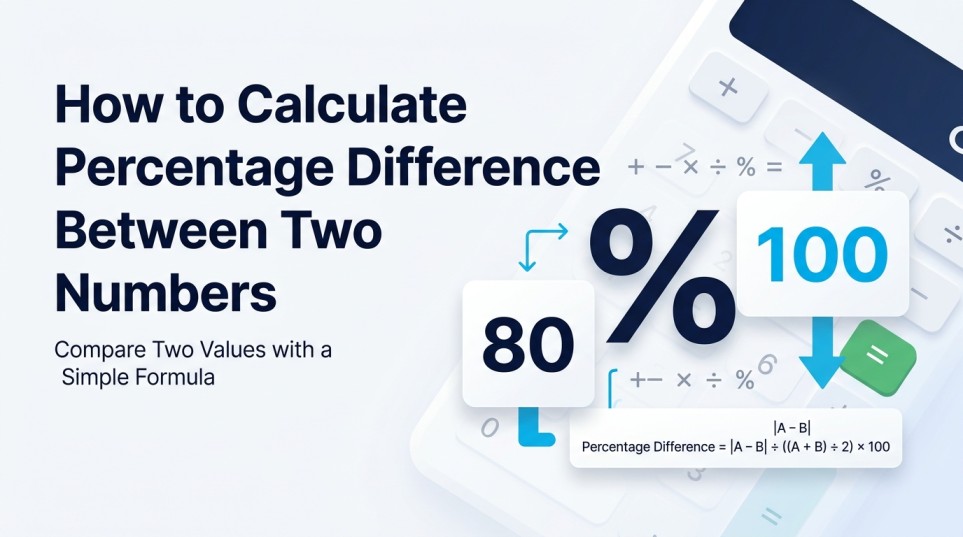
Comparing two numbers may seem easy, until you need to express their difference as a percentage. If you have two test results, two prices, two measurements, or two estimates, you might want to find out how much they differ rather than simply subtracting one from the other. Knowing how to calculate percentage difference helps you make that comparison in a clear and consistent way.
That is where percentage difference is useful. It tells you how large the gap between two values is relative to their average. Once you know which percentage method applies to your situation, the calculation will be quite simple. This guide explains how to calculate the percentage difference, shows the formula step by step, and explains how it differs from percentage change. Or use a percentage calculator instant.
Table of Contents
What Is Percentage Difference?
Percentage difference measures the relative gap between two numbers when neither number is necessarily the starting or original value.
For two values, the calculation uses their absolute difference and their average: Percentage Difference = |Value 1 − Value 2| ÷ [(Value 1 + Value 2) ÷ 2] × 100
The vertical lines mean that you use the absolute difference. In simple terms, subtract the smaller number from the larger one so the result is positive. For example, suppose one measurement is 80 and another is 100.
- Difference: 100 − 80 = 20
- Average: (100 + 80) ÷ 2 = 90
- Percentage difference: 20 ÷ 90 × 100 = 22.22%
So, the percentage difference between 80 and 100 is approximately 22.22%. This method is particularly useful when you are comparing two values without treating either one as the baseline.
How to Calculate Percentage Difference
You can calculate the percentage difference in three simple steps.
Step 1: Find the absolute difference
Subtract one number from the other and use the positive result. Example: Two numbers are 45 and 60. 60 − 45 = 15
Step 2: Find the average of the two numbers
Add the numbers and divide the result by 2. (45 + 60) ÷ 2 = 52.5
Step 3: Divide the difference by the average
Now divide 15 by 52.5 and multiply by 100: 15 ÷ 52.5 × 100 = 28.57%
Therefore, the percentage difference between 45 and 60 is approximately 28.57%. This approach works whether the two numbers represent prices, measurements, quantities, scores, or other comparable values.
Percentage Difference Formula
The percentage difference formula can be written as: Percentage Difference = |A − B| / [(A + B) / 2] × 100
Where:
- A is the first value.
- B is the second value.
- |A − B| is the positive difference between the values.
- (A + B) / 2 is the average of the two values.
Here is another example using 125 and 150:
- Difference: 150 − 125 = 25
- Average: (125 + 150) ÷ 2 = 137.5
- Percentage difference: 25 ÷ 137.5 × 100 = 18.18%
The result means the two values are about 18.18% apart relative to their average. That wording matters. It does not mean that 150 is 18.18% higher than 125. That would be a percentage increase, which uses a different calculation.
Percentage Difference Between Two Values: An Easy Example
Imagine you receive two estimates for the same home repair. One estimate is $1,200, while another is $1,500.
First find the difference: $1,500 − $1,200 = $300
Then calculate the average: ($1,200 + $1,500) ÷ 2 = $1,350
Now calculate the percentage difference: $300 ÷ $1,350 × 100 = 22.22%
The percentage difference between the two values is therefore 22.22%. Notice that the calculation does not ask which estimate came first. It simply describes how far apart the two amounts are.
If you instead wanted to know how much more expensive the $1,500 estimate is than the $1,200 estimate, you would use percentage increase: $300 ÷ $1,200 × 100 = 25%
Both answers are mathematically valid, but they answer different questions.
Percentage Difference vs Percentage Change
Understanding percentage difference vs percentage change is one of the most important parts of this calculation.
The key question is: Do you have a starting value?
If yes, percentage change is usually the better choice. If you are simply comparing two values and neither is the baseline, percentage difference is usually appropriate.
| Calculation | Best used when | Formula |
| Percentage difference | Comparing two values with no defined starting point | Difference ÷ Average × 100 |
| Percentage increase | A value rises from an original amount | Increase ÷ Original value × 100 |
| Percentage decrease | A value falls from an original amount | Decrease ÷ Original value × 100 |
| Percentage change | Comparing a new value with an original value | Change ÷ Original value × 100 |
For example, a product price goes from $50 to $60. The increase is $10.
Percentage increase: $10 ÷ $50 × 100 = 20%
But if you are comparing two prices of $50 and $60 without identifying one as the original price, their percentage difference is: $10 ÷ $55 × 100 = 18.18% The denominator changes the answer because the two calculations have different purposes. For a deeper explanation of the distinction, see this BMJ overview of percentage difference
How to Calculate Percentage of Two Numbers
People sometimes use “percentage of two numbers” to mean several different things, so it helps to identify the exact question first.
If you want to know what percentage one number is of another, divide the first number by the second and multiply by 100.
For example: 30 ÷ 120 × 100 = 25% So, 30 is 25% of 120.
If you want to compare how far apart two values are, use the percentage difference formula instead. For example, with 30 and 120:
- Difference = 90
- Average = 75
- Percentage difference = 90 ÷ 75 × 100 = 120%
This large result may seem surprising, but it is true for percentage differences. The values are far apart from their mean. So, before deciding how to calculate percentages, ask yourself what you are really trying to describe: a proportion, a change, or a difference. or you can see complete guide of how to find percentage of two numbers.
How to Compute Percentage Increase
To compute a percentage increase, you need an original value and a new value.
Use: Percentage Increase = (New Value − Original Value) ÷ Original Value × 100
Suppose a monthly subscription rises from $40 to $50. Increase: $50 − $40 = $10
Percentage increase: $10 ÷ $40 × 100 = 25%
The price increased by 25%. This should not be confused with the percentage difference between $40 and $50, which is 22.22%.
A useful rule is: The original value is important in the case of percentage increase. The average value is important in the case of percentage difference. This one difference prevents many calculation errors.
When Should You Use Percentage Difference?
Percentage difference is useful when two values are being compared on relatively equal terms. Common examples include:
- Comparing two measurements of the same object.
- Checking two independent estimates.
- Comparing results from two methods.
- Looking at two experimental measurements.
- Comparing two prices when neither is the official baseline.
- Checking how closely two calculated values agree.
- Comparing two readings from different sources.
For example, if two people measured a table and got 71 inches and 73 inches, you might want to describe the difference between their measurements, rather than claiming that one measurement is “larger” than the other. The percentage difference in that situation gives a more neutral comparison.
Common Mistakes to Avoid
A few small mistakes in percentage calculator, can produce a completely different answer.
Using the wrong denominator
The most common error is dividing by one of the two values instead of their average. For percentage difference, the denominator is the average of the two values.
Confusing difference with change
If one number is clearly the original value and the other is the new value, percentage change may be what you need. Do not automatically use percentage difference just because you have two numbers.
Forgetting the absolute difference
The order of subtraction should not make the percentage negative.
For example, 80 and 100 have the same percentage difference whether you calculate 100 − 80 or 80 − 100. Use the positive difference.
Rounding too early
Keep extra decimal places during the calculation and round the final percentage. Rounding the numbers too soon can slightly alter the result. For most everyday calculations, two decimal places are enough.
Assuming every percentage question has one formula
Questions involving percentages can look similar but require different methods. “30 is what percent of 120?” is different from “How much did 120 increases from 30?” and both are different from “What is the percentage difference between 30 and 120?”
Read the wording before reaching for a formula.
What If One of the Numbers Is Zero?
The standard percentage difference formula has a limitation when both values are zero. If A = 0 and B = 0, the average is also zero, so the formula would require division by zero. There is no meaningful percentage difference from this formula.
If only one value is zero, the calculation can still be performed. For example, comparing 0 and 20 gives:
- Difference = 20
- Average = 10
- Percentage difference = 20 ÷ 10 × 100 = 200%
That result can feel unusual, but it follows directly from the formula. The big lesson from this is that percentage calculations require context. Mathematically accurate results are not always the most effective way to describe real-world comparisons.
Frequently Asked Questions
Is percentage difference always positive?
Yes, when using the standard percentage difference formula. The absolute difference is used, so switching the order of the two values does not change the result.
Can percentage difference be more than 100%?
Yes. Percentage difference can exceed 100% when the difference between the values is larger than their average. For example, the percentage difference between 20 and 80 is 120%.
Is percentage difference the same as percentage error?
No. Percent error usually compares a measured or estimated value to a recognized or indicative value. Percent difference compares two values, where neither is considered the correct base value.
Which number goes first in the formula?
For percentage difference, it does not matter which value you call A or B. You use the absolute difference, so the final result is the same.
How do I calculate percentage difference in a calculator?
Subtract the two values, take the positive result, calculate the average of the values, divide the difference by that average, and multiply by 100. You can enter the entire expression at once if your calculator supports parentheses.
Why is my percentage difference different from my percentage increase?
These two formulas use different reference points. Percentage increase uses the original value, while percentage difference uses the average of the two values.
Conclusion
The main challenge with percentage problems is often not the arithmetic. It is choosing the correct comparison.
For percentage difference, find the positive difference between the two numbers, divide it by their average, and multiply by 100: Percentage Difference = |A − B| ÷ [(A + B) ÷ 2] × 100
Use this when you want a neutral comparison between two values. If one value is clearly the starting point, look at percentage increase, decrease, or change instead.
Once you identify what the two numbers represent, the right formula becomes much easier to choose—and your final percentage will have a clear meaning.
If you have quires or any question about our calculator, please Contact Us