
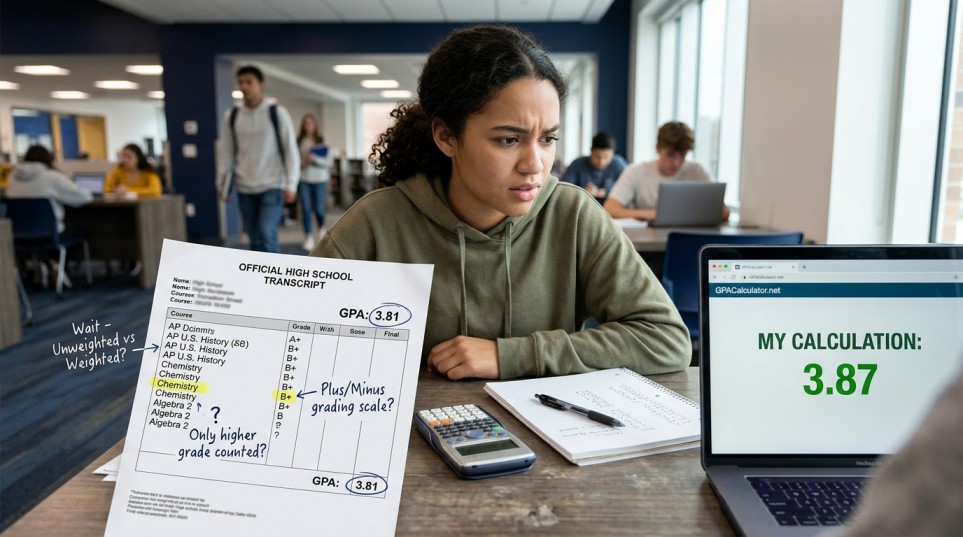
Your GPA can differ from your school’s GPA even when you entered your grades correctly. Many students asking, “why is my GPA different from school gpa?” The difference usually comes from the rules used to calculate the number: course weighting, credits, plus/minus grades, repeated courses, excluded classes, advanced-course bonuses, or rounding.
A generic U.S. GPA calculator can be mathematically correct according to its selected assumptions while still producing a different result from your school’s official GPA. The key question is not simply, “Which number is right?” It is, “Which calculation rules produced each number?” Your school’s transcript GPA reflects the policies used by that school. An online calculation is an estimate unless its settings match those policies exactly.
Credit weighting and course weighting are not the same thing
Students sometimes hear that their GPA is “weighted” and assume that means advanced classes receive extra points. But there are two different ideas that can affect a GPA calculation.
Credit weighting means courses with more credits have a larger effect on the GPA. For example, a 1.0-credit course contributes twice as much as a 0.5-credit course when the GPA is calculated using credit hours.
Course-level weighting means the grade points assigned to a course may change because of its course type, such as AP, Honors, or IB. A student can have both at the same time. A 1.0-credit AP class might receive additional grade points because it is an AP course, while a 0.5-credit class has less influence because it carries fewer credits.
If an online calculator treats every course equally but the school uses credits, the results can differ even before AP or Honors weighting is considered.
Table of Contents
A realistic example of a GPA mismatch
Suppose a student has these six courses:
| Course | Grade | Course type | Credits | Calculator treatment | Possible school treatment |
| English | A- | Regular | 1.0 | 3.7 points | 3.67 points |
| Algebra | B+ | Regular | 1.0 | 3.3 points | 3.33 points |
| U.S. History | A | Regular | 1.0 | 4.0 points | 4.00 points |
| Biology | B | Regular | 1.0 | 3.0 points | 3.00 points |
| AP Chemistry | A- | AP | 1.0 | 4.7 points | 4.67 points |
| Spanish III | A | Honors | 1.0 | 4.5 points | 4.50 points |
Assume the calculator uses 3.7 for A-, 3.3 for B+, and adds 0.7 to the AP course and 0.5 to the Honors course.
The calculation is: (3.7 + 3.3 + 4.0 + 3.0 + 4.7 + 4.5) ÷ 6 = 3.87
Now suppose the school uses 3.67 for A-, 3.33 for B+, adds 0.67 to AP courses, and adds 0.50 to Honors courses: (3.67 + 3.33 + 4.0 + 3.0 + 4.34 + 4.50) ÷ 6 = 3.81
Both calculations follow their respective rules correctly. The student did not necessarily enter anything incorrectly; the assumptions are different. That is why comparing the final numbers without comparing the underlying policies can be misleading.
Plus/minus grades can change the result
Not every GPA system assigns the same value to plus and minus grades. For example, one calculation might treat:
- A- as 3.7
- B+ as 3.3
- B- as 2.7
- C+ as 2.3
Another system might use values such as 3.67, 3.33, 2.67, and 2.33. Consider four equally weighted grades: A-, B+, B+, and A.
Using 3.7 and 3.3: (3.7 + 3.3 + 3.3 + 4.0) ÷ 4 = 3.575
Using 3.67 and 3.33: (3.67 + 3.33 + 3.33 + 4.0) ÷ 4 = 3.5825
The difference is small, but it becomes more noticeable across many courses. Some schools may also use a different plus/minus structure altogether.
Does an A+ always equal 4.0?
No. An A+ does not have one universally required GPA value across U.S. high schools. Depending on the school’s grading policy, an A+ might be treated as 4.0, a value above 4.0, or the same as another top grade for GPA purposes.
For example, imagine six courses containing two A+ grades. One calculator might assign each A+ 4.0 points, while another school system might assign 4.3 points.
Those two A+ grades alone would create a 0.10-point difference in a six-course GPA: (4.3 − 4.0) × 2 ÷ 6 = 0.10 So if your calculator has an A+ setting that does not match your school’s policy, the final GPA can differ even when every letter grade is correct.
Retaking a course can create a larger mismatch
A repeated course is another common source of confusion. Suppose a student originally earns a D in Algebra I and later retakes the course and earns a B. The school might:
- replace the original grade for GPA purposes,
- average the two attempts,
- count both attempts,
- exclude one attempt under a specific repeat policy,
- or apply another institutional rule.
For example, if both attempts were simply averaged on a 4.0 scale, a 1.0-point grade followed by a 3.0-point grade would produce: (1.0 + 3.0) ÷ 2 = 2.0
If the school replaces the D with the B, the GPA impact could instead be based only on the 3.0 grade. A calculator that does not know your school’s repeat-course policy cannot automatically reproduce the official transcript GPA. Check the school’s grading or transcript policy when a repeated class is involved.
Rounding can cause a small difference
Sometimes the calculation methods are almost identical, but the displayed number differs because of rounding.
Imagine the exact GPA is: 3.846666…
A school might display 3.85, while a calculator could display 3.847, 3.8467, or 3.8, depending on its settings. There is another possible difference: a system may round each course’s grade-point value before calculating the overall GPA, while another system keeps more decimal places internally and rounds only the final result.
For example, using 3.666… as an underlying value is not mathematically identical to first rounding it to 3.67 and then using 3.67 in every subsequent calculation. When the difference is only a few hundredths, check whether you are comparing the school’s displayed GPA with the calculator’s full-precision result.
“I calculated this semester’s grades, but my transcript GPA is different”
This often happens because the number you calculated from current classes represents only the new coursework, while the transcript GPA incorporates previous coursework. Suppose your previous cumulative GPA was 3.40 across 20 credits, and you earn a 4.00 GPA across 5 new credits.
The combined GPA is: (3.40 × 20 + 4.00 × 5) ÷ 25 = 3.52
Your new semester performance is 4.00, but your cumulative GPA is 3.52. So, comparing a semester calculation with the cumulative GPA printed on a transcript can make a perfectly correct calculation look wrong. Make sure the two numbers cover the same coursework. Need more clarification check how U.S. schools calculate GPA.
AP, Honors, and IB weighting varies by school
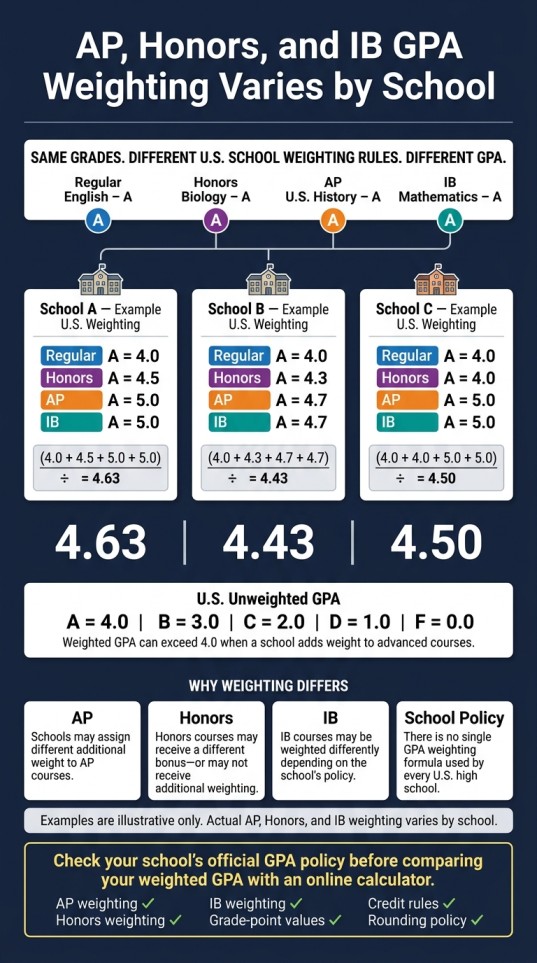
There is no single national formula that requires every U.S. high school to add the same number of points for AP, Honors, or IB courses. One school might add 1.0 point for an AP course. Another might use a smaller adjustment. A school might weight Honors differently from AP, or have separate rules for particular course levels.
For example, suppose a student earns an A in a regular course and an A in an AP course. If a calculator adds 1.0 point to the AP grade:
- Regular A = 4.0
- AP A = 5.0
But if the school’s policy adds 0.5:
- Regular A = 4.0
- AP A = 4.5
Across several advanced courses, that difference can materially change a weighted GPA. This is why the phrase “weighted GPA” by itself is not enough to reproduce a school’s official number. You need the school’s actual weighting policy.
Why does another GPA calculator give me a different answer?
Two calculators can produce different GPAs from exactly the same grades because they may be built around different assumptions. Check whether the calculators handle these items differently:
- A+ grades
- A-, B+, B-, and other plus/minus grades
- course credits
- AP, Honors, or IB weighting
- repeated courses
- pass/fail classes
- withdrawn or excluded courses
- rounding
For example, one calculator might assume every class is worth one equal unit, while another asks for credit hours. One might use a 4.0 maximum for an A+, while another allows a value above 4.0. Neither calculator is necessarily “wrong.” The useful question is which methodology better matches the school whose GPA you are trying to reproduce.
GPA mismatch checklist
If your calculated GPA does not match your transcript, check these items in order:
- Confirm whether the school reports weighted or unweighted GPA.
- Find the school’s grade-point table or grading policy.
- Check how AP, Honors, and IB courses are weighted.
- Check whether courses are weighted by credits.
- Compare the school’s treatment of A+, A-, B+, B-, and other plus/minus grades.
- Check the policy for repeated courses.
- Identify pass/fail, withdrawal, non-GPA, and excluded courses.
- Make sure you are comparing semester GPA with semester GPA, or cumulative GPA with cumulative GPA.
- Check how and when the GPA is rounded.
- Compare your final calculation with the official GPA on your transcript.
If the mismatch remains after these checks, ask your counselor, registrar, or school office which courses and grade points are included in the official calculation.
Which GPA should students trust?
If you need a GPA for a formal purpose-such as a college application, scholarship, transcript request, or another official process-use the GPA supplied by your school unless the institution or application gives different instructions.
An online calculator is useful for checking, planning, and estimating. It should not replace the official GPA reported by your school.
Colleges and other institutions can also evaluate academic records using their own processes. If an application asks you to report a GPA, follow that application’s instructions rather than assuming that an online recalculation should replace the number on your transcript.
When a GPA calculator is useful
A high school GPA calculator can still be very useful even when it does not exactly reproduce your school’s official number. You can use it to:
- check whether your manual calculation is reasonable,
- estimate your GPA before official grades are posted,
- compare “what-if” grade scenarios,
- see how an individual grade could affect your average,
- identify possible data-entry mistakes,
- understand why a change in grades changes your estimated GPA.
The key is to treat the result as a calculation based on the settings you selected. For an exact match with your transcript, those settings need to reflect your school’s actual GPA policy. You can see the complete guide on how to raise your GPA in college.
FAQ
Why is my GPA higher than my school’s GPA?
Your calculation may be using more favorable assumptions than your school. Common causes include different AP/Honors weighting, different plus/minus values, excluding a course incorrectly, treating all courses as equally weighted when the school uses credits, or handling repeated courses differently.
Why is my transcript GPA lower than my calculator GPA?
Check whether your calculator has included bonus points for advanced classes that your school does not use, or whether it has excluded grades that your school counts. Also verify whether you calculated only your recent courses while the transcript number is cumulative.
Why do two GPA calculators give different results?
Calculators can use different assumptions for A+, plus/minus grades, credits, advanced-course weighting, repeated courses, excluded classes, and rounding. Entering the same grades does not guarantee the same result if the calculation rules differ.
Can my school use a different GPA scale?
Yes. Schools can use different grading and weighting policies. A 4.0-based system is common, but the way letter grades, advanced courses, credits, and other transcript entries are converted into GPA can vary.
Why did retaking a class change my GPA differently than expected?
Your school may have a specific repeat-course policy. It might replace the original grade, count both attempts, average the attempts, or apply another rule. A generic calculator may not know which policy your school uses.
Does an A+ always equal 4.0?
No. The GPA value assigned to an A+ depends on the grading policy being used. Some systems treat it as 4.0, while others may assign a different value or handle it in another way.
Can a college use a different GPA than the one on my transcript?
A college may evaluate an academic record using its own admissions methodology, depending on its policies and the information it receives. That does not mean the student’s school transcript is incorrect. Follow the specific college’s instructions if it asks you to report or calculate a GPA in a particular way.
Related tools
Percentage Calculator – Easily calculate Percentage Difference Between Two Numbers.
Units Converter – Use the AI Units Converter to convert anything with ease.