
Use the Hand Size Comparison Tool to place two hands side by side or overlay them and see the differences in size and proportions.
Distance from bottom wrist crease to middle fingertip.
Breadth across the knuckles (excluding thumb).
Distance from bottom wrist crease to middle fingertip.
Breadth across the knuckles (excluding thumb).
About Hand Size Comparison Visualizer
This hand size comparison visualizer takes two sets of measurements, hand length and palm width, and draws proportional silhouettes so you can judge the gap with your eyes instead of reading two numbers off a tape measure.
You might want it to compare your hand with a partner’s, see how a child’s hand is growing, check whether a hand span is realistic for a piano piece, or settle a debate about who has the bigger hands. All you need is a ruler and about two minutes. You can enter inches or centimeters, so use whichever your ruler shows.
Table of Contents
How to Use the Hand Size Comparison Visualizer
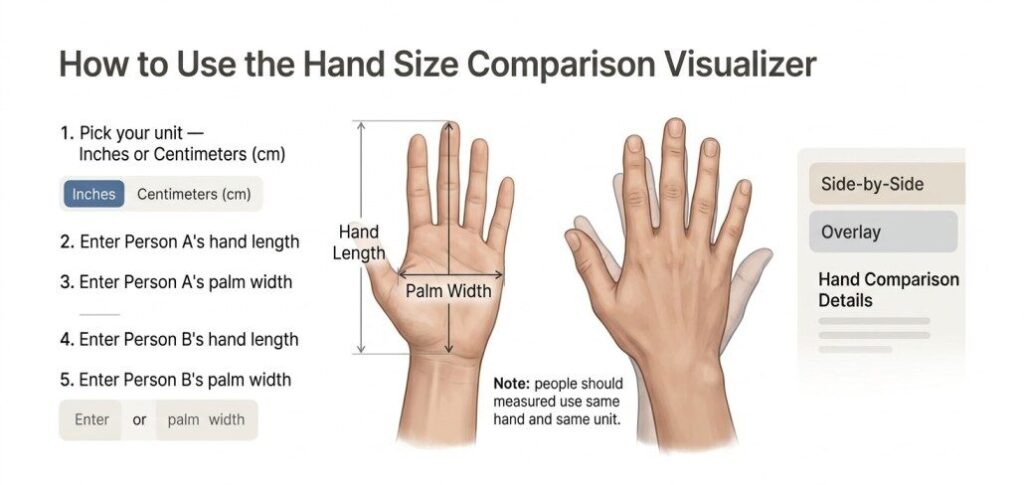
- Pick your unit. Choose Inches or Centimeters (cm) first. Switching units afterward is fine, but enter both people’s numbers in the same unit.
- Enter Person A’s hand length. This is measured from the wrist to the tip of the middle finger (details in the measuring section below).
- Enter Person A’s palm width. This is measured across the knuckles.
- Repeat for Person B. Use the same hand for both people, and measure in the same way.
- Read the visualization and the text result. Switch between the side-by-side view and the overlay view, then check the Hand Comparison Details underneath.
How to measure hand size
Measure the dominant hand or the same hand for everyone, because left and right hands often differ slightly. Lay the hand flat on a table, palm up, fingers together and relaxed but straight. A clear plastic ruler works better than a tape measure here because you can see the skin through it. Or check out how researchers define and take hand measurements.
Hand length (wrist to tip). Find the crease where the palm meets the wrist. If there are a couple of creases, use the one closest to the palm. Measure in a straight line from that crease to the tip of the middle finger. The most common error is measuring from the middle of the forearm or the wrist bone, which makes the hand look longer than it is.
Palm width (knuckles). With the hand still flat, measure straight across the four knuckles where the fingers join the palm, from the outer edge of the index finger’s knuckle to the outer edge of the little finger’s knuckle. Leave the thumb out. Don’t squeeze the ruler into the skin, and don’t spread the fingers wide, since that adds width the tool isn’t expecting.
Round to the nearest 1/8 inch or the nearest millimeter. Beyond that, the measurement error from your own technique is bigger than the extra precision. One thing people often mix up is hand span, the distance from thumb tip to little finger tip with the hand stretched wide. That’s a different measurement, and it isn’t one of the inputs here. It matters for piano, basketball and similar uses, but this tool compares length and palm width.
What the Comparison Shows
The tool produces two kinds of output: a picture and a short text summary.
Side-by-side view. Both hands are drawn at the same scale, standing next to each other. This is the clearest way to see overall difference at a glance, such as which hand is longer and how much wider the palm is.
Direct overlay view. The hands are stacked, so you can see exactly where one extends past the other. Because the silhouettes share a baseline at the wrist, differences show up mainly at the fingertips and the sides of the palm. This view is better for asking, “How much longer would the fingers need to be to match?”
Hand Comparison Details. This lists the measurements you entered for Hand A and Hand B, followed by two differences:
- Length Difference: how much longer or shorter one hand is from wrist to fingertip.
- Palm Width Difference: how much wider or narrower one palm is across the knuckles.
Keep the two differences separate in your mind. A hand can be much longer yet only slightly wider, which is why a hand that looks “bigger” in one respect can look ordinary in another.
How the Differences Are Worked Out
There’s no complicated formula behind a visualizer. The text results are simple subtraction:
Difference = Larger measurement − Smaller measurement
If you want to convert between units yourself:
Centimeters = Inches × 2.54
Where the difference tells you how far apart two hands are in a single dimension, and 2.54 is the exact number of centimeters in one inch.
The picture is drawn from those same values: the silhouette is scaled so its length and its knuckle width match what you entered. The shape itself is a general hand outline, so treat it as a proportional guide and not a scan of anyone’s actual hand.
Worked Example
Say Person A has a hand length of 7.5 in and a palm width of 3.5 in, and Person B has a hand length of 6.8 in and a palm width of 3.1 in.
- Length difference: 7.5 − 6.8 = 0.7 in
- Palm width difference: 3.5 − 3.1 = 0.4 in
In centimeters, the same hands are:
- Person A: 7.5 × 2.54 = 19.05 cm long, 3.5 × 2.54 = 8.89 cm wide
- Person B: 6.8 × 2.54 = 17.27 cm long, 3.1 × 2.54 = 7.87 cm wide
The differences are 19.05 − 17.27 ≈ 1.78 cm in length and 8.89 − 7.87 ≈ 1.02 cm in width, which matches 0.7 in and 0.4 in once converted. If you also want a sense of proportion, divide the difference by the smaller hand. Length: 0.7 ÷ 6.8 ≈ 10.3% longer. Width: 0.4 ÷ 3.1 ≈ 12.9% wider. This step is for your own reference and isn’t something the tool displays. What it means: Person A’s hand is about three-quarters of an inch longer and roughly a half-inch wider across the palm. In the overlay view you’d see Person A’s fingertips extend a little past Person B’s, and Person A’s palm edges poke out slightly on both sides.
When This Tool Is Useful
- Comparing two people. Partners, siblings, a parent and child, or two friends can see their actual differences instead of guessing from a handshake.
- Watching a child grow. Measure once and revisit the tool every few months. Comparing a child with an adult in the overlay view makes growth very visible.
- Hand size and instruments. Pianists, guitarists and violinists sometimes want to know whether a stretch or chord shape is realistic for them. Rachmaninoff is the classic reference point here. He is widely described as having unusually large hands and being able to reach very wide intervals on the keyboard, which is part of why his piano writing is known for large stretches. His exact measurements aren’t reliably documented, so there is no authoritative figure to enter.
- Sports, gloves and grips. Comparing hands is a quick way to see why one person finds a ball, glove or racket grip comfortable and another doesn’t.
- Handheld size comparison. When choosing a phone, controller or other handheld device, comparing your hand to a friend who owns it can tell you more than the spec sheet. If you need the device dimensions themselves, our Screen Size Comparison tool is the better place for screen sizes.
- Curiosity and settling debates. Sometimes you just want to know whose hand is bigger.
Common Mistakes
- Measuring different hands. If one person enters a left hand and the other a right hand, small natural differences get mistaken for real ones.
- Starting at the wrong point. Measure from the wrist crease at the base of the palm, not from the forearm. Starting too far back inflates the length.
- Including the thumb in palm width. Palm width is the knuckle line of the four fingers only.
- Mixing units. Entering 7.5 for one person in inches and 19 for the other in centimeters (without switching the unit) will give a nonsensical picture. Pick one unit before typing numbers.
- Measuring a spread or tense hand. Spread fingers add width, and a clenched or arched hand shortens the length. Keep the hand flat and relaxed.
- Treating the silhouette as a fingerprint. Finger thickness, finger length relative to the palm, and thumb size all vary between people. The silhouette shows overall proportion, not an exact replica.
Hand Length vs. Hand Span
These two terms get confused constantly, and for some searches, like a hand size comparison for piano, the distinction matters. Hand length is a straight measurement from wrist to fingertip. It tells you how far the hand reaches forward. Hand span is the distance between the thumb tip and little fingertip with the hand fully stretched sideways. It tells you how wide an interval or grip you can cover.
Two people can have identical hand lengths and quite different spans because of flexibility and finger proportions. This visualizer compares length and palm width, so use it as a proportion guide and not as a prediction of what you can stretch.
Accuracy, Assumptions, and Limitations
The comparison is only as good as the measurements you enter. A tape-measure error of an eighth of an inch matter when two hands differ by half an inch, so measure carefully and, if possible, measure twice. The tool assumes a generalized hand shape scaled to your two numbers. It doesn’t capture finger length ratios, thumb length, finger thickness, or how flexible a hand is. Two hands with the same length and palm width can still look and feel different.
Hands also change over the day. Swelling from heat, exercise or a long flight can add a few millimeters, and children and teenagers change within months. If you’re comparing over time, measure at a similar time of day. Finally, the results describe measured size. They are not a medical assessment, a glove or equipment fit guarantee, or a prediction of ability at any activity.
Reference Table: Quick Measurement Guide
| Measurement | Where to measure | Unit | Common mistake |
| Hand length | Wrist crease to tip of middle finger, hand flat | in or cm | Starting on the forearm |
| Palm width | Across the four knuckles, thumb excluded | in or cm | Spreading the fingers |
Reference Table: Inches to Centimeters
Handy if your ruler and the tool use different units.
| Inches | Centimeters |
| 2.5 | 6.35 |
| 3.0 | 7.62 |
| 3.5 | 8.89 |
| 4.0 | 10.16 |
| 6.0 | 15.24 |
Frequently Asked Questions
How do I measure hand size at home?
Use a ruler with your hand flat, palm up. Measure from the wrist crease to the tip of your middle finger for length, and across the four knuckles for width.
What counts as an average hand size?
It depends on age, sex and population, and there’s no single “normal” number. Use the tool to compare against a specific person or a published figure you trust, not a vague average.
Do I need to measure both hands?
No. Measure the same hand for both people. If the left and right differ, use the one you care about.
Can I compare my hand to Rachmaninoff’s?
You can, but his measurements aren’t reliably documented, so any figure you enter is an estimate. The result will be an illustration, not a historical fact.
Why do the side-by-side and overlay views look different?
The side-by-side view shows both hands separately at the same scale. The overlay stacks them so you can see exactly where one extends past the other.
Can I compare a child’s hand to an adult’s?
Yes. Enter the measurements for each in the same unit and use the overlay view to see the difference clearly.
Related Tools
If you enjoy comparing real-world sizes, try our Screen Size Comparison tool for phones, tablets and laptops, the TV Size Comparison tool for how a television fits a space, or the Monitor Size Comparison tool for desk setups.